Earth's Place in the Universe
- Physics
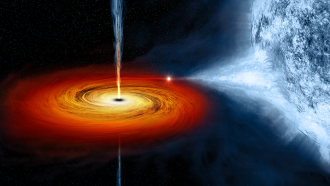
Explainer: What are black holes?
Among the most extreme celestial bodies in the universe, black holes are dense, massive entities whose gravity can sometimes hold together an entire galaxy.
- Chemistry
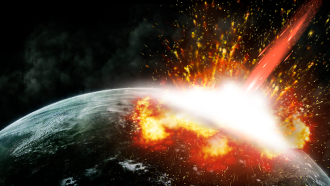
Asteroids may have delivered water to early Earth
Scientists shot mineral pellets at a simulated planet. It showed an impact wouldn’t have boiled off all of an asteroid’s water.
- Physics
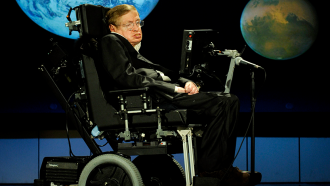
Disabilities don’t stop these experts in science and tech
People with disabilities are as varied as the careers some of them pursue in science, technology, engineering and math.
- Planets
Small, distant worlds are either big Earths or little Neptunes
The Kepler space telescope data are in. They split Earth-like exoplanets into two groups and reveal 10 new rocky planets in the ‘Goldilocks’ zone.
- Planets
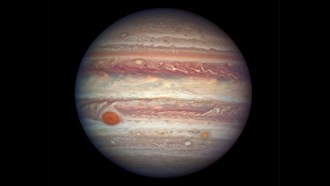
Jupiter may be the solar system’s oldest planet
Jupiter’s early existence may explain the odd arrangement of planets in the solar system, a new study suggests.
- Planets
Hot, hot planet sets sizzling new record
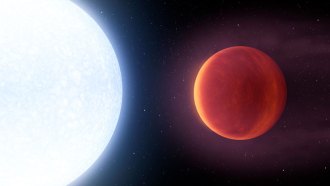
Astronomers have discovered an odd new exoplanet. Called KELT 9b, is the hottest non-star known.
- Physics
Gravitational waves detected yet again
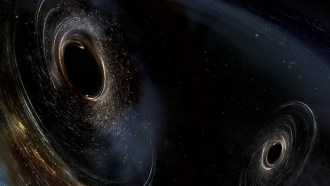
For the third time in 16 months, scientists have announced detection of gravitational waves washing over the spacetime environment in which Earth resides. This seems to show that such waves may not be rare.
- Planets
Jupiter gets surprisingly complex new portrait
NASA’s Juno spacecraft has sent back unexpected details about Jupiter, giving scientists their first close-up of this gas giant.
- Space
How the solar system’s tail disappeared
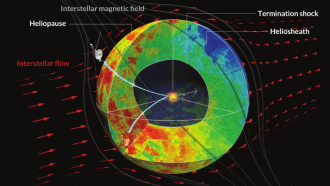
A bubble envelops the planets and other material in the solar system. New data show it does not have a long tail but is round.
- Tech
Teens garner some $4 million in prizes at 2017 Intel ISEF
Hundreds of teens collectively took home about $4 million in awards from the Intel International Science and Engineering Fair this week.
- Physics
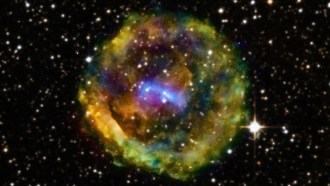
After 30 years, this supernova is still sharing secrets
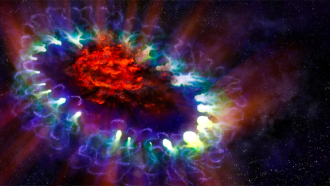
It’s been 30 years since astronomers first witnessed the stellar explosion known as SN 1987A. Today, researchers are still learning from this cataclysmic phenomenon.
- Space
Scientists Say: Supernova
When a star has too much mass, it can explode. The explosion is called a supernova.