HS-ESS1-1
Develop a model based on evidence to illustrate the life span of the sun and the role of nuclear fusion in the sun's core to release energy that eventually reaches Earth in the form of radiation.
- Physics
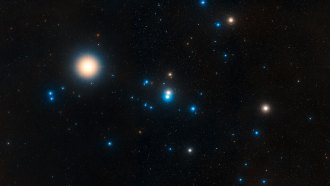
Milky Way’s tidal forces are shredding a nearby star cluster
The nearest star cluster is being pulled apart, due largely to the tidal forces of our galaxy, the Milky Way. Bye bye, Hyades!
- Physics
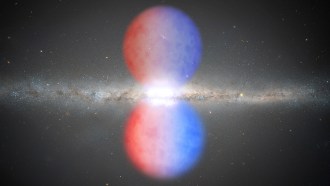
Spotted: Milky Way’s giant gas bubbles in visible light
The bubbles have different colors, based on how the gas inside them moves. That could give clues to how the bubbles developed.
- Earth
Newfound ‘dunes’ is among weirdest of northern lights
There’s a new aurora dubbed the 'dunes.' It’s weird and joins the ranks of black auroras, STEVE and other odd natural light shows.
- Physics
NASA’s Parker probe spots rogue waves and magnetic islands on the sun
The Parker probe’s first data is giving scientists a look at what’s to come as the craft moves closer to the sun over the next few years.
- Physics
Magnetic fields may supercharge the sun’s release of heat
Astronomers have linked flame-like tendrils rising from the sun to changes in its magnetic fields. This may be one step toward understanding why the sun’s corona is so very, very hot.
- Physics
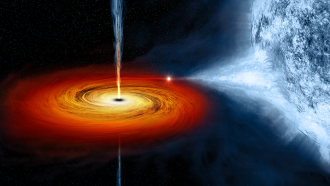
Explainer: What are black holes?
Among the most extreme celestial bodies in the universe, black holes are dense, massive entities whose gravity can sometimes hold together an entire galaxy.
- Physics
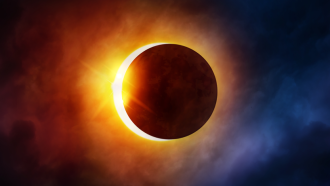
Eclipses come in many forms
Eclipses are one of nature’s most awesome spectacles, and scientists have learned a lot by observing them and related celestial alignments — occultations and transits.
- Space
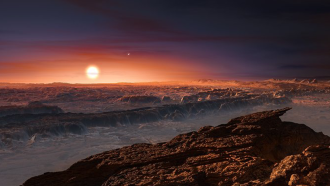
Sun’s nearest stellar neighbor may have Earth-like planet
A planet roughly the size of Earth orbits within the “Goldilocks” zone of the Proxima Centauri. Only 4.2 light-years away, this star is the one closest to our sun.
- Space
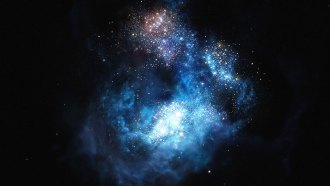
A new, nonexplosive source of black holes?
At least one black hole may have formed from the collapse of a cloud of gas, which is not the usual birthing scheme. This might even be how some of the earliest gargantuan black holes developed.
- Physics
Cool Jobs: Solar sleuthing
No star is closer than the sun, and yet there’s much science still don’t know about how it actually works. These scientists are helping solve the mysteries.
- Physics
Machine simulates the sun’s core
A machine heats iron atoms to temperatures that match the interior of the sun. This has helped solve a solar mystery.
- Animals
When life exploded
Life exploded in diversity during the Cambrian Period. Experts are exploring what could account for this sudden change 540 million years ago.