ammonia: A colorless gas with a nasty smell. Ammonia is a compound made from the elements nitrogen and hydrogen. It is used to make food and applied to farm fields as a fertilizer. Secreted by the kidneys, ammonia gives urine its characteristic odor. The chemical also occurs in the atmosphere and throughout the universe.
astrobiologist: Someone who studies life everywhere in the universe, including on Earth and in space.
atmosphere: The envelope of gases surrounding Earth, another planet or a moon.
bacteria: (singular: bacterium) Single-celled organisms. These dwell nearly everywhere on Earth, from the bottom of the sea to inside other living organisms (such as plants and animals). Bacteria are one of the three domains of life on Earth.
carbon dioxide: (or CO2) A colorless, odorless gas produced by all animals when the oxygen they inhale reacts with the carbon-rich foods that they’ve eaten. Carbon dioxide also is released when organic matter burns (including fossil fuels like oil or gas). Carbon dioxide acts as a greenhouse gas, trapping heat in Earth’s atmosphere. Plants convert carbon dioxide into oxygen during photosynthesis, the process they use to make their own food.
cell: (in biology) The smallest structural and functional unit of an organism. Typically too small to see with the unaided eye, it consists of a watery fluid surrounded by a membrane or wall. Depending on their size, animals are made of anywhere from thousands to trillions of cells. Most organisms, such as yeasts, molds, bacteria and some algae, are composed of only one cell.
chemical: A substance formed from two or more atoms that unite (bond) in a fixed proportion and structure. For example, water is a chemical made when two hydrogen atoms bond to one oxygen atom. Its chemical formula is H2O. Chemical also can be an adjective to describe properties of materials that are the result of various reactions between different compounds.
cloud: A plume of molecules or particles, such as water droplets, that move under the action of an outside force, such as wind, radiation or water currents. (in atmospheric science) A mass of airborne water droplets and ice crystals that travel as a plume, usually high in Earth’s atmosphere. Its movement is driven by winds.
crust: (in geology) Earth's outermost surface, usually made from dense, solid rock (in planetary science) the outermost surface of rocky planets, dwarf planets and natural satellites.
exoplanet: Short for extrasolar planet, it’s a planet that orbits a star outside our solar system.
extraterrestrial: (ET) Anything of or from regions beyond Earth.
germ: Any one-celled microorganism, such as a bacterium or fungal species, or a virus particle. Some germs cause disease. Others can promote the health of more complex organisms, including birds and mammals. The health effects of most germs, however, remain unknown.
host: (in biology and medicine) The organism (or environment) in which some other thing resides. Humans may be a temporary host for food-poisoning germs or other infective agents. (v.) The act of providing a home or environment for something. A website, for instance, could host photos, news or other types of information.
hue: A color or shade of some color.
hydrogen: The lightest element in the universe. As a gas, it is colorless, odorless and highly flammable. It’s an integral part of many fuels, fats and chemicals that make up living tissues. It’s made of a single proton (which serves as its nucleus) orbited by a single electron.
inhospitable: A term for conditions that make life unpleasant or hard to survive.
landfill: A site where trash is dumped and then covered with dirt to reduce smells. If they are not lined with impermeable materials, rains washing through these waste sites can leach out toxic materials and carry them downstream or into groundwater. Because trash in these facilities is covered by dirt, the wastes do not get ready access to sunlight and microbes to aid in their breakdown. As a result, even newspaper sent to a landfill may resist breakdown for many decades.
light-year: The distance light travels in one year, about 9.46 trillion kilometers (almost 6 trillion miles). To get some idea of this length, imagine a rope long enough to wrap around the Earth. It would be a little over 40,000 kilometers (24,900 miles) long. Lay it out straight. Now lay another 236 million more that are the same length, end-to-end, right after the first. The total distance they now span would equal one light-year.
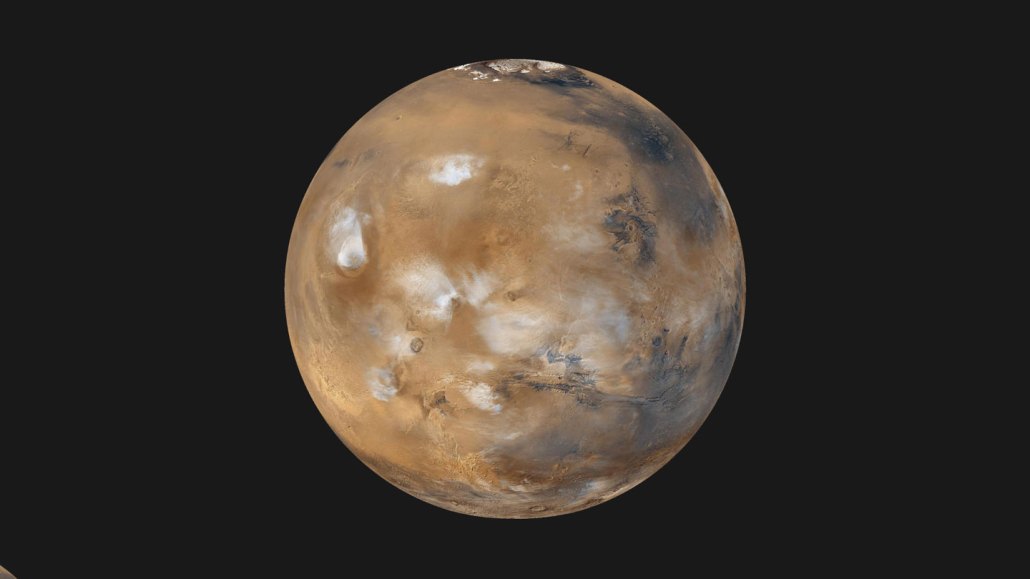
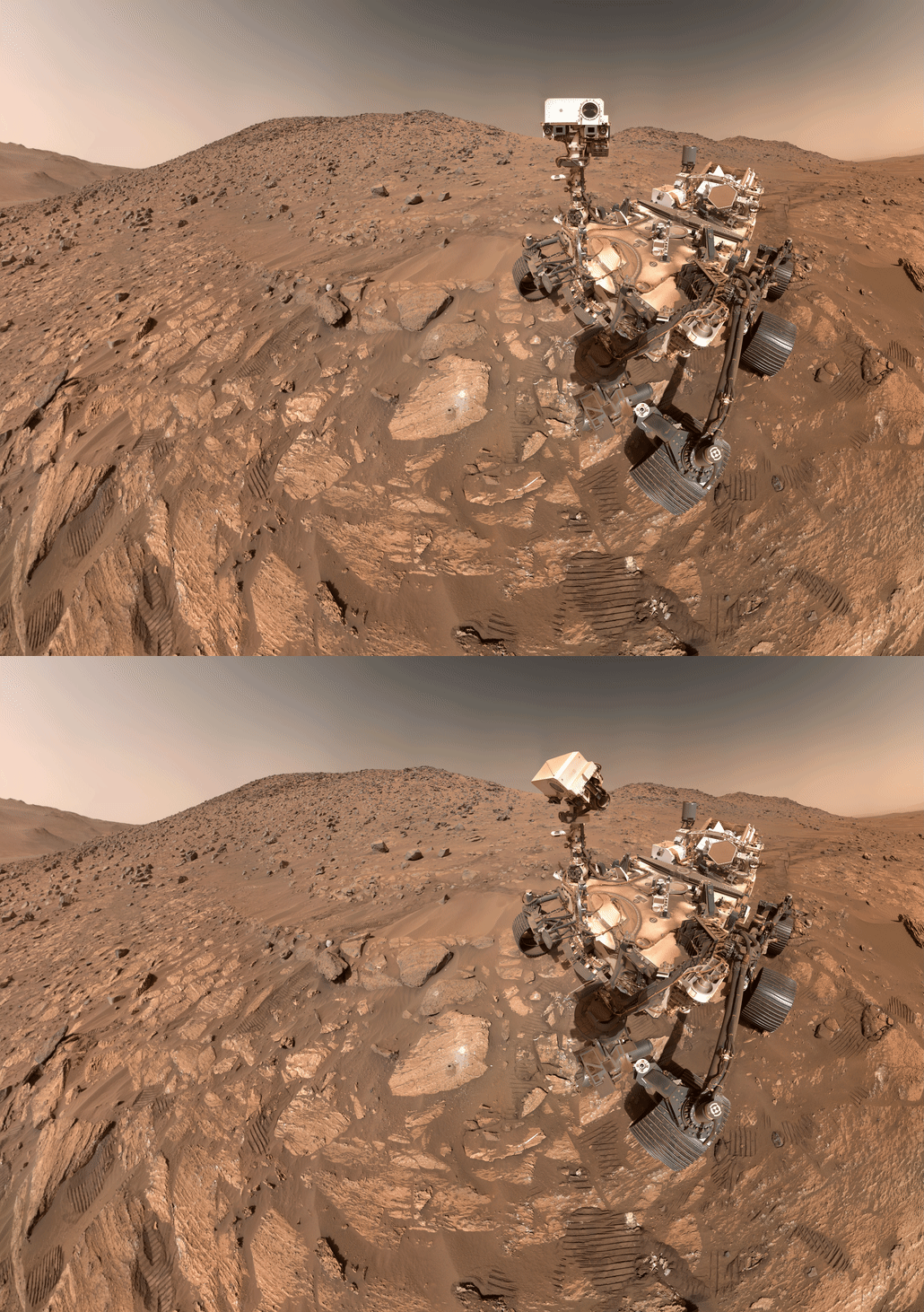
Mars: The fourth planet from the sun, just one planet out from Earth. Like Earth, it has seasons and moisture. But its diameter is only about half as big as Earth’s.
methane: A hydrocarbon with the chemical formula CH4 (meaning there are four hydrogen atoms bound to one carbon atom). It’s a natural constituent of what’s known as natural gas. It’s also emitted by decomposing plant material in wetlands and is belched out by cows and other ruminant livestock. From a climate perspective, methane is 80 times more potent than carbon dioxide is in trapping heat in Earth’s atmosphere, making it a very important greenhouse gas.
NASA: Short for the National Aeronautics and Space Administration. Created in 1958, this U.S. agency has become a leader in space research and in stimulating public interest in space exploration. It was through NASA that the United States sent people into orbit and ultimately to the moon. It also has sent research craft to study planets and other celestial objects in our solar system.
orbiter: A spacecraft designed to go into orbit, especially one not intended to land.
oxygen: A gas that makes up about 21 percent of Earth's atmosphere. All animals and many microorganisms need oxygen to fuel their growth (and metabolism).
phosphine: A very toxic colorless gas that smells a bit like garlic. Each molecule of it contains one phosphorus atom bonded to three hydrogen atoms.
pigment: A material, like the natural colorings in skin, that alter the light reflected off of an object or transmitted through it. The overall color of a pigment typically depends on which wavelengths of visible light it absorbs and which ones it reflects. For example, a red pigment tends to reflect red wavelengths of light very well and typically absorbs other colors. Pigment also is the term for chemicals that manufacturers use to tint paint.
planet: A large celestial object that orbits a star but unlike a star does not generate any visible light.
pressure: Force applied uniformly over a surface, measured as force per unit of area.
radiation: (in physics) One of the three major ways that energy is transferred. (The other two are conduction and convection.) In radiation, electromagnetic waves carry energy from one place to another. Unlike conduction and convection, which need material to help transfer the energy, radiation can transfer energy across empty space.
Red Planet: A nickname for Mars.
sewage: Wastes — primarily urine and feces — that are mixed with water and flushed away from homes through a system of pipes for disposal in the environment (sometimes after being treated in a big water-treatment plant).
solar system: The eight major planets and their moons in orbit around our sun, together with smaller bodies in the form of dwarf planets, asteroids, meteoroids and comets.
star: The basic building block from which galaxies are made. Stars develop when gravity compacts clouds of gas. When they become hot enough, stars will emit light and other forms of electromagnetic radiation. The sun is our closest star.
stratosphere: The second layer of the Earth’s atmosphere, just above the troposphere, or ground layer. The stratosphere stretches from roughly 14 to 64 kilometers (9 to about 31 miles) above sea level.
system: A network of parts that together work to achieve some function. For instance, the blood, vessels and heart are primary components of the human body's circulatory system. Similarly, trains, platforms, tracks, roadway signals and overpasses are among the potential components of a nation's railway system. System can even be applied to the processes or ideas that are part of some method or ordered set of procedures for getting a task done.
technology: The application of scientific knowledge for practical purposes, or the devices, processes and systems that result from those efforts.
telescope: Usually a light-collecting instrument that makes distant objects appear nearer through the use of lenses or a combination of curved mirrors and lenses. Some, however, collect radio emissions (energy from a different portion of the electromagnetic spectrum) through a network of antennas.
ultraviolet light: A type of electromagnetic radiation with a wavelength from 10 nanometers to 380 nanometers. The wavelengths are shorter than that of visible light but longer than X-rays.
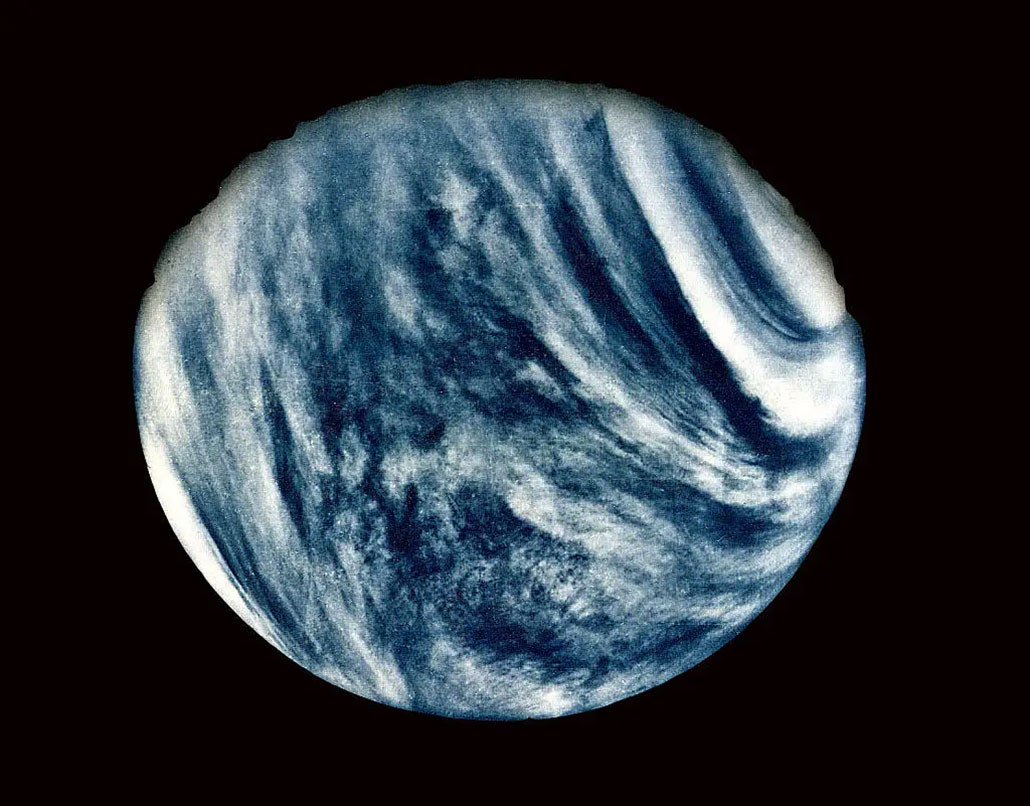
Venus: The second planet out from the sun. Just as Earth does, it has an iron core and a rocky mantle and crust. Volcanoes on the planet’s surface spewed high levels of carbon dioxide, which built up in the planet’s atmosphere. Today the air pressure at the planet’s surface is 100 times greater than on Earth, and the atmosphere now keeps the surface of Venus a brutal 460° Celsius (860° Fahrenheit).
wavelength: The distance between one peak and the next in a series of waves, or the distance between one trough and the next. It’s also one of the “yardsticks” used to measure radiation. Visible light — which, like all electromagnetic radiation, travels in waves — includes wavelengths between about 380 nanometers (violet) and about 740 nanometers (red). Radiation with wavelengths shorter than visible light includes gamma rays, X-rays and ultraviolet light. Longer-wavelength radiation includes infrared light, microwaves and radio waves.