HS-ESS1-4
Use mathematical or computational representations to predict the motion of orbiting objects in the solar system.
- Planets
First mega-Earth found
Astronomers are puzzled by Kepler-10c. This exoplanet is rocky like Earth — but as massive as Neptune. And that challenges their accepted ideas about how planets form.
- Space
Sun sibling spotted
Separated at birth: Astronomers find a star 110 light-years away. It was born at the same time as our sun and from the same cloud of gas and dust.
- Planets
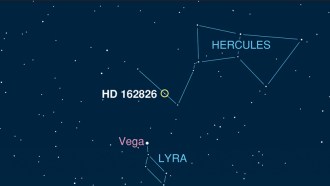
Distant planet may boast the longest year
On a planet far, far away, a single pass around its sun may seem to last forever.
- Planets
Heavenly research
Groundbreaking research in astronomy landed four high school seniors spots as finalists in the 2014 Intel Science Talent Search.
- Planets
Surprising rings circle comet-asteroid hybrid
It’s too small to be a planet. Yet this planet wannabe still resembles Saturn-like giants. It’s the smallest solar system inhabitant to, like them, host rings of orbiting ice.
- Space
Galaxy drags trail of newborn stars
Distant galaxy plows through cluster of others, with baby stars in tow
- Space
Star cluster rockets through space
It’s the first time astronomers have ever detected a cluster of stars moving collectively at such speed.
- Planets
Double sunsets on a distant world
Astronomers discover for the first time a planet circling two stars.
-
- Planets
The growing planetary family
At least 1,200 added to list of possible planets beyond the solar system.
- Space
A dusty birthplace
Evidence of separate bands of dust suggests the presence of a planet orbiting a young star.
- Space
Burst busters
A powerful type of explosion in outer space is much more common, but not always as powerful, as astronomers had thought.