HS-PS4-5
Communicate technical information about how some technological devices use the principles of wave behavior and wave interactions with matter to transmit and capture information and energy.
- Health & Medicine
‘Smart’ sutures monitor healing
Coatings added to the threads used to stitch up a wound let researchers use electrical signals to monitor a wound’s healing — even one covered by a bandage.
- Physics
Scientists Say: Watt
Say Watt? This is a unit used to measure the flow of energy being used.
- Physics
How to catch a gravity wave
Physicists have just announced finding gravity waves. The phenomenon was predicted a century ago by Einstein’s theory of general relativity. Here’s what it took to detect the waves.
- Physics
Boom! Sounding out the enemy
Armistice Day marked the end of the Great War. But what arguably won the war was acoustics — the science of sound. It allowed Allied troops to home in on and rout the enemy.
- Physics
Einstein taught us: It’s all ‘relative’
One hundred years ago, a German physicist shared some math he had been working on. In short order, his theory of relativity would revise forever how people viewed the universe.
- Brain
Scientists Say: MRI
MRI is a technique used to diagnose diseases and to study the body. The machine can map internal structures, all the way down to tiny blood vessels.
- Chemistry
Cool Jobs: Saving precious objects
Museum conservators are experts at protecting and restoring precious objects. Along with art or history, many also have studied chemistry, physics, archaeology or other scientific fields.
- Archaeology
Laser vision reveals hidden worlds
From discovering ancient ruins to forecasting climate change, the laser mapping technology called lidar is changing many fields of science.
- Tech
Explainer: What are lidar, radar and sonar?
Radar, sonar and lidar and are three similar technologies. Each relies on the echoing of waves — radio, sound or light waves — to detect objects.
- Animals
Mates or survival: Which explains a bird’s color?
When male birds are brightly colored, we assume that’s because their plumage attracts the gals. But a new study with thousands of museum specimens shows that sometimes survival is just as important a factor behind bird color.
- Physics
How to pick up messages after they’re gone
By watching for light’s ‘echoes,’ physicists think they can retrieve information being relayed by or as light. It could make it possible for astronomers to view distant objects without having to see the light they cast off.
- Health & Medicine
Vision-ary high tech
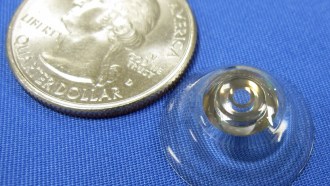
New devices are being developed to improve, restore or preserve the vision of people with eye diseases, such as glaucoma and macular degeneration. One device is a telescopic contact lens than can be zoomed with a wink.