MS-ESS1-3
Analyze and interpret data to determine scale properties of objects in the solar system.
- Planets
Analyze This: Some 5,000 planets orbit stars other than our sun
A new cache of confirmed exoplanet discoveries marks a milestone in planets found beyond our solar system.
- Earth
Scientists Say: Atmosphere
An atmosphere is an envelope of gas around a planet, dwarf planet or moon.
- Planets
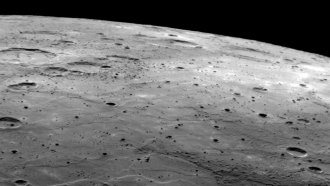
Mercury’s surface may be studded with diamonds
Billions of years of meteorite impacts may have transformed much of Mercury's graphite crust into precious gemstones.
- Planets
Let’s learn about Pluto
Once known as a pipsqueak planet, Pluto is now the solar system’s best known dwarf planet.
- Physics
Scientists Say: Doppler effect
The Doppler effect is a perceived change in the frequency of light or sound waves due to the wave source moving relative to an observer.
- Tech
Space trash could kill satellites, space stations — and astronauts
As private companies prepare to sprinkle space with tens of thousands of satellites, experts worry about the mushrooming threat of space junk.
- Physics
Scientists Say: Dark Energy
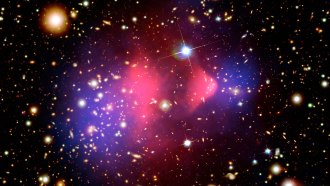
Dark energy is the unknown force causing the universe to expand faster and faster.
- Physics
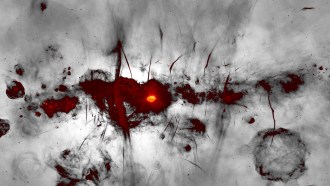
Wild art? No, it’s a radio image of the heart of our Milky Way
Eyelash-like radio filaments accent the brightest feature in this image — a supermassive black hole.
- Physics
Explainer: Telescopes see light — and sometimes ancient history
Different kinds of telescopes on Earth and in space help us to see all wavelengths of light. Some can even peer billions of years back in time.
- Planets
The long-awaited James Webb Space Telescope has a big to-do list
The James Webb Space Telescope has been in the works for so long that new fields of science have emerged for it to study.
- Space
Scientists Say: Solar wind
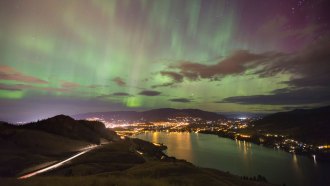
This is a powerful gust of charged particles that flows out from the sun through the solar system.
- Planets
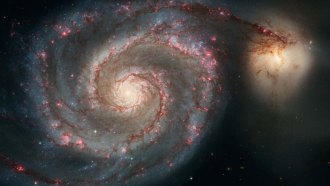
Astronomers may have found first known planet in another galaxy
The spiral-shaped Whirlpool galaxy may be home to the first planet spotted outside our own Milky Way galaxy.