Physics
- Computing
LEDs offer new way to kill germs in water
Growing ultraviolet-light-emitting diodes on thin, flexible sheets of metal holds promise for water disinfection and other applications.
- Physics
Weird physics warps nearby star’s light
Scientists have observed a bizarre effect of quantum physics in light coming from a nearby neutron star.
- Computing
Wind power gets downsized — but in a good way
Two young scientists have developed ways to tap into wind power on a small scale.
- Materials Science
3-D printers offer better way to make some magnets
3-D printers produced magnets as strong as conventional ones with less material wasted.
- Computing
Star Trek technology becomes more science than fiction
On Star Trek, the characters used devices that seemed wild, futuristic and impossible. But those sci-fi gadgets are inspiring real-world, useful inventions.
- Physics
Scientists Say: Diffraction
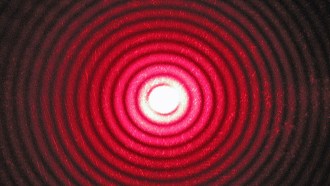
When liquid hits something it spatters, when light hits something, it scatters. The process is called diffraction.
- Physics
Hack: How to spy on a 3-D printer
Computer scientists have found that a hacker can eavesdrop on a 3-D printer using a smartphone. The technique uses sound and energy data produced by the printer.
- Animals
Our shocking eel story wins international prize
Roberta Kwok’s story on the shocking (and surprising) behaviors of electric eels was honored with a win for outstanding science writing.
- Animals
Peacock spider’s radiant rump comes from teeny tiny structures
Male peacock spiders have highly colored hind ends that they shake to attract females. Scientists have now figured out the physics responsible for those hues.
- Chemistry
New coating for metals could cut engine wear
Scientists have developed a new coating for engine parts that could reduce friction and engine wear. One big benefit: Cars may require fewer oil changes.
- Math
Math predicts weird materials; leads to 2016 physics Nobel
The 2016 Nobel Prize in physics will go to three researchers that have made discoveries about exotic states of matter.
- Physics
Explainer: How heat moves
Energy moves through the universe one of three ways: conduction, convection and radiation. Only radiation can occur through empty space.