All Stories
- Genetics
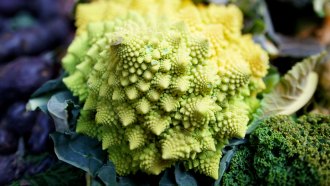
How Romanesco cauliflower grows spiraling fractal cones
By tweaking just three genes in a common lab plant, scientists have mimicked one of nature’s most impressive mathematical patterns.
- Physics
Scientists Say: Mass
Mass shows how much an object resists speeding up or slowing down when force is applied — a measure of how much matter is in it.
- Genetics
Just a tiny share of the DNA in us is unique to humans
Some of these tweaks to DNA, however, may have played a role in brain evolution.
- Climate
Warming cities may see more rain — and frequent flooding
Scientists are seeking to understand why and how to mop up excess precipitation.
- Climate
Explainer: Urban heat islands and how to cool them
Cities transform landscapes covered in plants to ones covered in heat-absorbing asphalt and concrete. But ways exist to cool these urban heat islands.
- Climate
Stores and malls buy into ponds and rain gardens for flood control
An extra bonus: These rainy-day ponds clean up that dirty water running off parking lots.
- Chemistry
New glue offers to turn any small walking robot into Spider-Man
To climb walls, robot feet need to alternately stick and let go. A novel adhesive can do that. Its stickiness is controlled by electric fields.
- Chemistry
Explainer: What is an electrode?
An electrode’s name depends on the circumstances. Confused? It may help to consider which electrochemical reaction is natural — and which is not.
- Chemistry
Explainer: Ions and radicals in our world
When atoms get an electric charge, they act very differently. Now called ions, these are behind many aspects of chemistry, including acids and batteries.
- Environment
Let’s learn about plastic pollution
The world is cluttered with plastic waste. All that junk kills animals far and wide.
- Animals
Even raised by people, wolves don’t tune into you like your dog
Dog puppies outpace wolf pups at engaging with humans, even with less exposure to people, supporting the idea that domestication changed dogs’ brains.
- Chemistry
Lots of makeup may contain potentially harmful ‘forever chemicals’
Hints of PFAS compounds have turned up in about half of tested makeup products. Waterproof mascaras and lipsticks were very likely to contain them.