All Stories
- Genetics
How fake sugar can lead to overeating
Scientists have found that fruit flies and mice eat more after consuming food laced with a popular fake sugar.
- Earth
Something in plastics may be weakening kids’ teeth
The body can confuse some pollutants for a natural hormone. Researchers in France now find such pollutant exposures in childhood may lead cells to make defective tooth enamel.
- Earth
Non-scents: Pollution can confuse pollinators’ sniffers
New research uses computers to predict how much longer it takes bees and other pollinating insects to sniff out lunch in a polluted environment.
-
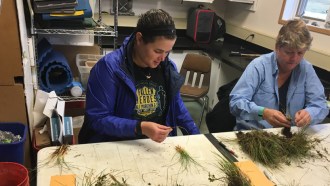
Teachers get to do cool science in the Arctic
The Toolik Field Station offers a hands-on research experience for science teachers, so they can take the latest techniques back to their classrooms.
- Animals
Plants, animals adapt to city living
Cities have turned into experiments in evolution for both plants and animals, from the taste of clover to the stickiness of lizards’ toes.
- Space
A new, nonexplosive source of black holes?
At least one black hole may have formed from the collapse of a cloud of gas, which is not the usual birthing scheme. This might even be how some of the earliest gargantuan black holes developed.
- Genetics
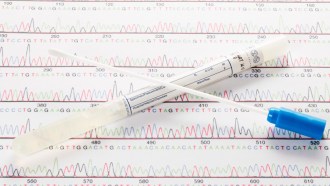
Scientists Say: DNA sequencing
All of us have our own individual DNA. Now, scientists can determine what each individual strand is made of — a process called DNA sequencing.
- Animals
End of Latin America’s Zika epidemic is in sight
A computer simulation suggests the Zika epidemic in Latin America is peaking and may not strike hard again for up to three decades.
- Health & Medicine
New study raises questions about cell phone safety
U.S. government study in rats links cell-phone radiation to a small increase in brain cancers and heart tumors. Some scientists now worry about lifetime risks to today’s children and teens.
-
Get Science News magazines for free in your high school
A new program is offering Science News free for high schools, complete with materials to guide classroom reading and an archive spanning more than 94 years.
- Animals
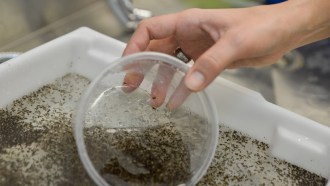
GM mosquitoes cut rate of viral disease in Brazil
Adults males carrying the altered gene cannot father young that survive to adulthood. That’s when they suck blood — and can transmit disease.
- Health & Medicine
Don’t use dinner-table spoons for liquid medicines!
Kids are safer when parents use precise tools to measure liquid medicines. Switching from teaspoons to metric tools could help, a new study finds.