All Stories
- Archaeology
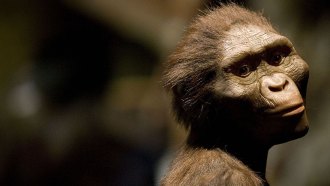
‘Cousin’ Lucy may have fallen from a tree to her death 3.2 million years ago
A contested study suggests that Lucy, a famous fossil ancestor of humans, fell from a tree to her death.
- Science & Society
What does a scientist look like? You!
We’re writing a feature on women in science, technology, engineering and math. Are you one? Share your story with us!
- Health & Medicine
‘Smart’ sutures monitor healing
Coatings added to the threads used to stitch up a wound let researchers use electrical signals to monitor a wound’s healing — even one covered by a bandage.
- Environment
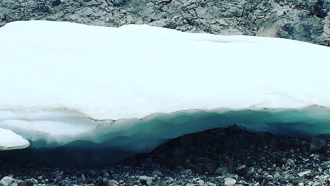
Scientists Say: Aufeis
Water keeps flowing underground even in the coldest Arctic winters. But when it comes to the surface, it chills out and forms large layers of ice — called aufeis.
- Space
Some white dwarf stars point to possible dark matter
Certain white-hot stars are cooling too fast for scientists to explain — unless they consider the presence of “axions.” These never-seen, but suspected particles could be shuttling away the extra energy from these cooling dwarf stars.
- Brain
Our eyes can see single specks of light
The human eye can detect a single photon. This discovery answers questions about how sensitive our eyes are. It hints at the possibility of using our eyes to study issues of quantum-scale physics.
-
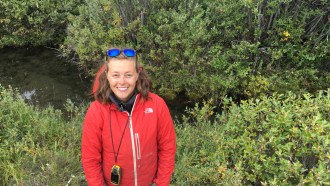
A Day in the Life: Arctic ecologist
Ever wonder what a scientist in the Arctic does all day? Mary Kate Swenarton scrubs rocks, catches fish and measures stream flow, depth, temperature and more.
- Animals
Beetles offer people lessons in moisture control
Taking tricks from a beetle, researchers are designing surfaces that collect water from the air or resist frost buildup.
- Space
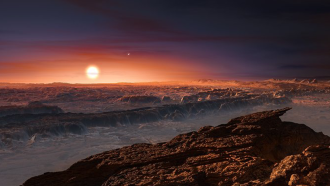
Sun’s nearest stellar neighbor may have Earth-like planet
A planet roughly the size of Earth orbits within the “Goldilocks” zone of the Proxima Centauri. Only 4.2 light-years away, this star is the one closest to our sun.
- Ecosystems
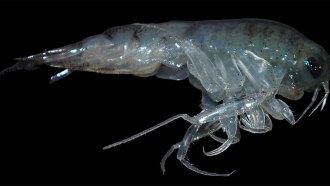
Algae embedded in sea ice drive the Arctic food web
Scientists traced where zooplankton in the Arctic get their energy from. Many open ocean species rely on algae found in sea ice, which is disappearing.
- Microbes
Staph infections? The nose knows how to fight them
Bacteria living in some people’s noses make a compound that could help fight a nasty type of infection that laughs at other antibiotics.
- Planets
Jupiter’s Great Red Spot is really, really hot
The Great Red Spot, a storm churning on Jupiter for at least 150 years, may be helping to keep the planet warm, a new study finds.