Precise tee placement can improve golf driving, teen finds
This middle-school engineer built a golf-ball-hitting machine out of a clay-pigeon launcher

Brady Sage tinkered with a clay-pigeon launcher to hit golf balls. His re-engineered device helped him investigate the best tee placement for hitting golf balls down the green.
Society for Science
This is a human-written story voiced by AI. Got feedback? Take our survey . (See our AI policy here .)
Brady Sage, 15, has been playing golf with his dad since he was a kid. For the last four years, he’s been seriously trying to improve his game. He was struggling to hit the ball far and straight with his driver. (That’s the club used for that first long shot down the green.) So Brady set out to see whether tweaking the way he tees up his ball would improve his drives. And it did.
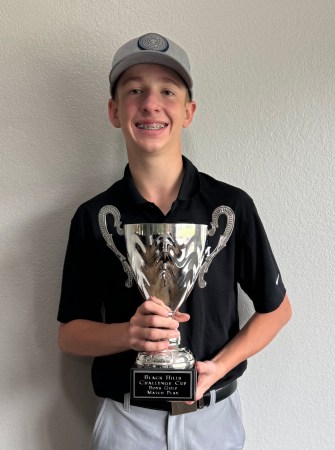
What he learned earned him a finalist spot at the 2025 Thermo Fisher Scientific Junior Innovators Challenge. There, Brady won the first-place engineering award. (The program is run by Society for Science, which also publishes Science News Explores.)
An aspiring engineer, Brady did this project as an eighth grader at Saint Thomas More Middle School in Rapid City, S.D. First, he built a machine that could hit a golf ball the same way over and over. To do this, he altered a clay-pigeon thrower — a device that launches targets for hunting practice.
Brady’s modified device swung the clubhead of a driver to hit a golf ball. He had it hit balls off tees of different heights above the ground — from 1.5 to 3 centimeters (0.6 to 1.2 inches). He also had it hit balls off tees that were positioned slightly forward or backward, relative to the club. And to make a golf ball soar, he found, a high tee placed farther backward generally worked best — unless there was wind.
Hitting a ball into the wind was a different challenge. Now, placing a tee lower and farther forward worked better. Why? It kept the ball low, so the wind didn’t mess with its trajectory as much.
Here, Brady shares his research experiences and insights.
What was your biggest challenge?
“Coming up with a way to hit the golf balls consistently,” Brady says. “We as human beings are not perfect, and whenever I try to hit the golf ball it goes different.”
The idea for his machine came while he was visiting his grandparents’ farm and found one of his grandfather’s clay-pigeon throwers. “To rig the device, it took around a month,” he says. “I had to tinker with it a lot, because at first it couldn’t get the ball off the ground.”
What was the most rewarding part?
“That I was able to take all of my data and use this information on the course myself,” Brady says. “Before this project, I was struggling with my driver all year. That was my worst club. And it seems that this kind of clicked, because now I love the driver.”
What’s next?
“My clay-pigeon thrower has a tiny spring,” Brady says. So it couldn’t hit golf balls that far. “If I could somehow make the spring larger — like use a garage-door spring or something — then I could see larger differences in my data.” Comparing bigger differences between longer hits could lead to more detailed insights into how tee position affects driving success.
“I would also like to try other golf clubs to see how I could improve on those,” he adds.