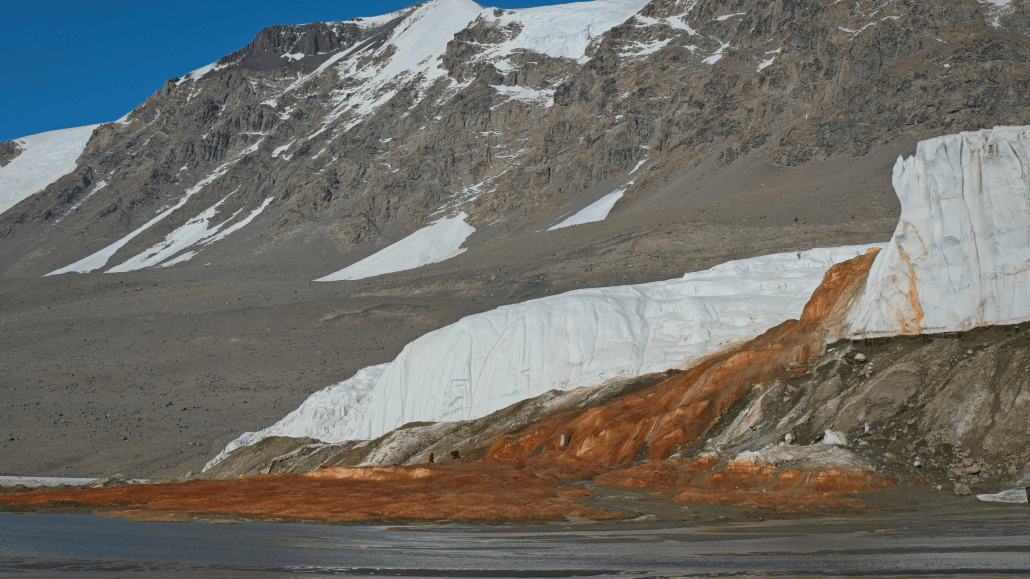
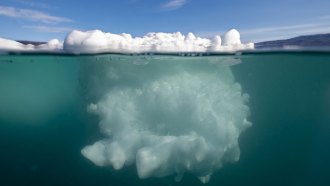
Antarctica: A continent mostly covered in ice, which sits in the southernmost part of the world.
atmosphere: The envelope of gases surrounding Earth, another planet or a moon.
crystal: (adj. crystalline) A solid consisting of a symmetrical, ordered, three-dimensional arrangement of atoms or molecules. It’s the organized structure taken by most minerals. Apatite, for example, forms six-sided crystals. The crystalline components of a rock are usually too small to be seen with the unaided eye.
extract: (v.) To separate one chemical (or component of something) from a complex mix. (noun) A substance, often in concentrated form, that has been removed from some source material. Extracts are often taken from plants (such as spearmint or lavender), flowers and buds (such as roses and cloves), fruit (such as lemons and oranges) or seeds and nuts (such as almonds and pistachios). Such extracts, sometimes used in cooking, often have very strong scents or flavors.
extremophile: A microorganism that lives in conditions of extreme temperature, acidity, alkalinity or concentrations of chemicals.
glacier: A slow-moving river of ice hundreds or thousands of meters deep. Glaciers are found in mountain valleys and also form parts of ice sheets.
iron: A metallic element that is common within minerals in Earth’s crust and in its hot core. This metal also is found in cosmic dust and in many meteorites.
Mars: The fourth planet from the sun, just one planet out from Earth. Like Earth, it has seasons and moisture. But its diameter is only about half as big as Earth’s.
molecule: A group of atoms that represents the smallest possible amount of a chemical compound. Molecules can be made of single types of atoms or of different types. For example, the oxygen in air is made of two bound oxygen atoms (O2). Water is made of two hydrogen atoms and one oxygen atom (H2O).
moon: The natural satellite of any planet.
New Zealand: An island nation in the southwest Pacific Ocean, roughly 1,500 kilometers (some 900 miles) east of Australia. Its “mainland” — consisting of a North and South Island — is quite volcanically active. In addition, the country includes many far smaller offshore islands.
oxygen: A gas that makes up about 21 percent of Earth's atmosphere. All animals and many microorganisms need oxygen to fuel their growth (and metabolism).
planet: A large celestial object that orbits a star but unlike a star does not generate any visible light.
respiration: (in cells) The process by which organisms produce energy from sugars, usually by taking in oxygen and releasing carbon dioxide.
salt: A compound made by combining an acid with a base (in a reaction that also creates water). The ocean contains many different salts — collectively called “sea salt.” Common table salt is a made of sodium and chlorine.
strategy: A thoughtful and clever plan for achieving some difficult or challenging goal.
sulfate: A family of chemical compounds that are related to sulfuric acid (H2SO4). Sulfates occur naturally in drinking water.
thermal: Of or relating to heat. (in meteorology) A relatively small-scale, rising air current produced when Earth’s surface is heated. Thermals are a common source of low level turbulence for aircraft.
vent: (n.) An opening through which gases or liquids can escape. (v.) To free gases or liquids that had been under pressure. The term can also be used to release strong, pent-up emotions, such as anger.