Could Spider-Man really turn off his superpowers?
A superpower “inhibitor” in Spider-Man: Brand New Day uses a real-world therapy called RNA interference

In Spider-Man: Brand New Day, the web-slinger builds a superpower inhibitor. It’s based on real science for treating diseases.
Sony Pictures
Note: Slight spoilers ahead for Spider-Man: Brand New Day.
In Spider-Man: Brand New Day, Peter Parker has disturbing symptoms caused by DNA from the spider bite that gave him superpowers. He’d like to get rid of some of his new features while keeping others. So he visits Bruce Banner to discuss a device Banner invented to keep his own alter-ego, the Hulk, in check. It’s a superpower inhibitor. And it’s based on actual treatments for diseases.
In one scene, Parker asks Banner how the inhibitor turns off the genes in his DNA that cause Banner to Hulk out. “You’re using target-specific short interfering RNA, right?” Parker asks.
That’s not just movie technobabble. Short interfering RNAs, or siRNAs, are real molecules. They can effectively “turn off” some of a person’s genes. The U.S. Food and Drug Administration has approved at least eight siRNA treatments for genetic diseases. Others are in clinical trials. Parker builds a device that injects siRNAs to control his unwanted powers.
siRNAs to the rescue
siRNAs work by interrupting a cell’s chemical assembly line.
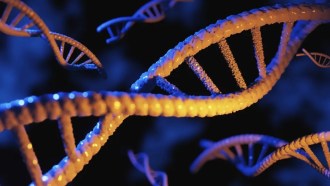
The instructions to build and maintain a living thing are housed in its DNA. And the pieces of DNA responsible for different traits are called genes.
To put a bit of DNA into action, a cell first makes copies of its chemical instructions. Those copies are known as messenger RNAs, or mRNAs. Other parts of the cell then read mRNA instructions to build proteins. Proteins are molecules that carry out various tasks inside a living thing.
Small interfering RNAs do their work in between the DNA-copying and protein-building steps. They can latch onto mRNAs carrying instructions from specific genes. That marks those mRNAs for destruction, and they get chopped up. The interference prevents proteins from being made from those mRNAs. It essentially silences the genes whose instructions the mRNAs had copied.
Some siRNAs occur naturally in cells. They help control protein production. But scientists have also designed siRNAs to silence genes that cause disease.
Silencing spidey genes
Shutting down foreign DNA — such as DNA from a spider — is the sort of thing siRNAs do well, says Anastasia Khvorova. She’s a chemical biologist at the University of Massachusetts Chan Medical School in Worcester.
If Spider-Man’s powers come from a single gene, then an siRNA targeting that gene could work, she says. But in the film, Parker wants to shut off several traits, such as making spiderweb silk and having painfully heightened senses. It’s rare for a single gene to control such different traits. So Parker would probably need to make a mix of different siRNAs to tackle all his new spider traits.
Plus, genes don’t work in isolation, says Khvorova. Shutting one down may affect others. In the movie, Banner warns that “it would be enormously dangerous and complex” to shut down some parts of Hulk but keep others.
Silencing a gene
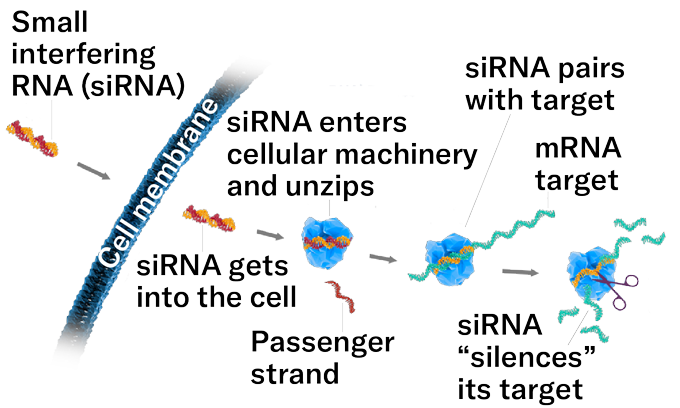
RNA interference, or RNAi, is one way cells control protein production. Molecules called small interfering RNAs enter the cell as a double-stranded pair (orange and red, left). Once in the cell, the siRNA enters a cellular machine called RISC. There, the two strands unzip. One strand (orange) pairs with a target messenger RNA, or mRNA, that carries instructions for making a specific protein. That pairing slates the mRNA for destruction and it is chopped up. No protein can be made from that mRNA and its corresponding gene.
siRNAs used to treat disease work like natural ones. But they have their own superpowers, Khvorova says. “They’re fully chemically modified.” The tweaks make them stable in the body and send them to the correct organ.
So far, all FDA-approved siRNAs work in the liver. Khvorova’s team is crafting others that can be sent to muscles, nerves or other organs.
With great power comes some limitations
Usually, siRNAs don’t completely shut off a gene. But they can meddle enough that very little of its protein gets built, says Judy Lieberman. She’s an immunologist at Boston Children’s Hospital and Harvard Medical School. She was an advisor to the company that first pioneered using siRNAs to treat diseases.
Slowing protein production to just a trickle might help Spider-Man control the level of his superpowers, Lieberman says. He would want enough protein made to make him super, but not enough to cause problems.
Unfortunately, no one has been able to tune siRNAs so precisely.
Spider-Man would also need the inhibitor to work everywhere in his body. That’s not something siRNAs are usually designed to do, says Gane Ka-Shu Wong. He’s a biomedical scientist at the University of Alberta in Edmonton, Canada.
Do you have a science question? We can help!
Submit your question here, and we might answer it an upcoming issue of Science News Explores
And there’s one more issue with siRNAs that could be a problem for the web-slinger. “They tend to last,” Wong says. Current siRNA therapies may last for six months or longer with a single dose.
Parker would likely want an inhibitor that breaks down, Wong says. “It’s got to last long enough to get to where it needs to go and shut off whatever it needs to shut off. But it also needs to degrade so that the moment you stop injecting this drug,” the powers return.
Even then, taking the inhibitor off wouldn’t instantly return a superhero’s powers. At a minimum, it could take a few hours to make mRNA copies and get new proteins. But it would probably take longer to return to full power.
“He could reverse it,” Lieberman says, “but it might take a few days.”