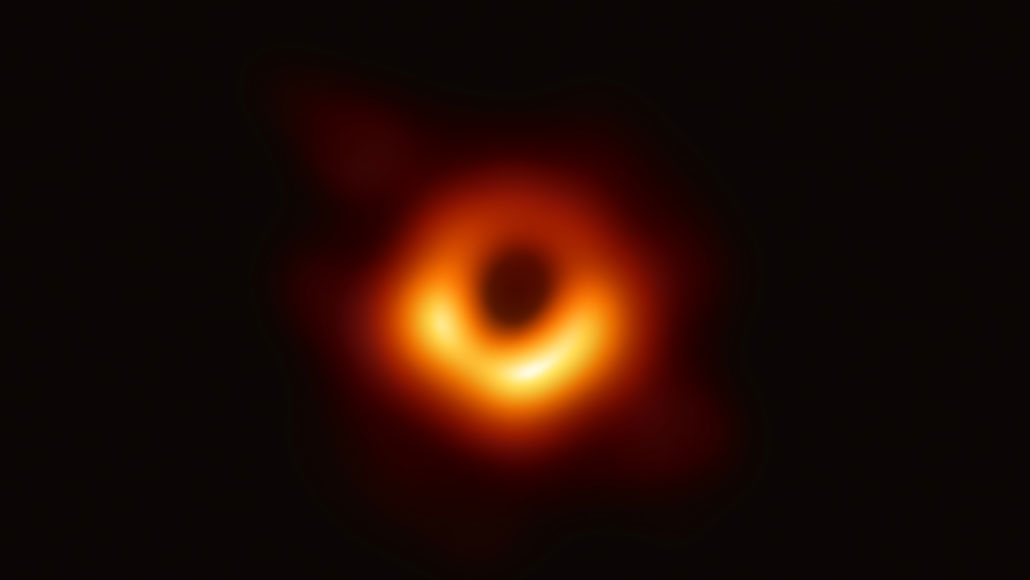
black hole: A region of space having a gravitational field so intense that no matter or radiation (including light) can escape.
disk: A round, flat and usually fairly thin object. (in astronomy) A rotating cloudlike collection of gases, dust or both from which planets may form. Or the structure of certain large rotating bodies in the cosmos, including spiral galaxies.
event horizon: An imaginary sphere that surrounds a black hole. The more massive the black hole, the bigger the sphere. Anything that happens inside the event horizon is invisible, because gravity is so strong that under normal circumstances even light can’t escape. But according to some theories of physics, in certain situations small amounts of radiation can escape.
galaxy: A group of stars — and usually invisible, mysterious dark matter — all held together by gravity. Giant galaxies, such as the Milky Way, often have more than 100 billion stars. The dimmest galaxies may have just a few thousand. Some galaxies also have gas and dust from which they make new stars.
gravity: The force that attracts anything with mass, or bulk, toward any other thing with mass. The more mass that something has, the greater its gravity.
information: (as opposed to data) Facts provided or trends learned about something or someone, often as a result of studying data.
light-year: The distance light travels in one year, about 9.46 trillion kilometers (almost 6 trillion miles). To get some idea of this length, imagine a rope long enough to wrap around the Earth. It would be a little over 40,000 kilometers (24,900 miles) long. Lay it out straight. Now lay another 236 million more that are the same length, end-to-end, right after the first. The total distance they now span would equal one light-year.
matter: Something that occupies space and has mass. Anything on Earth with matter will have a property described as "weight."
speed of light: A constant often used in physics, corresponding to 1.08 billion kilometers (671 million miles) per hour.
telescope: Usually a light-collecting instrument that makes distant objects appear nearer through the use of lenses or a combination of curved mirrors and lenses. Some, however, collect radio emissions (energy from a different portion of the electromagnetic spectrum) through a network of antennas.
velocity: The speed of something in a given direction.