Fuzzy microbes may fuel cows’ methane burps
A tiny part in some cow gut microbes kicks off production of this greenhouse gas
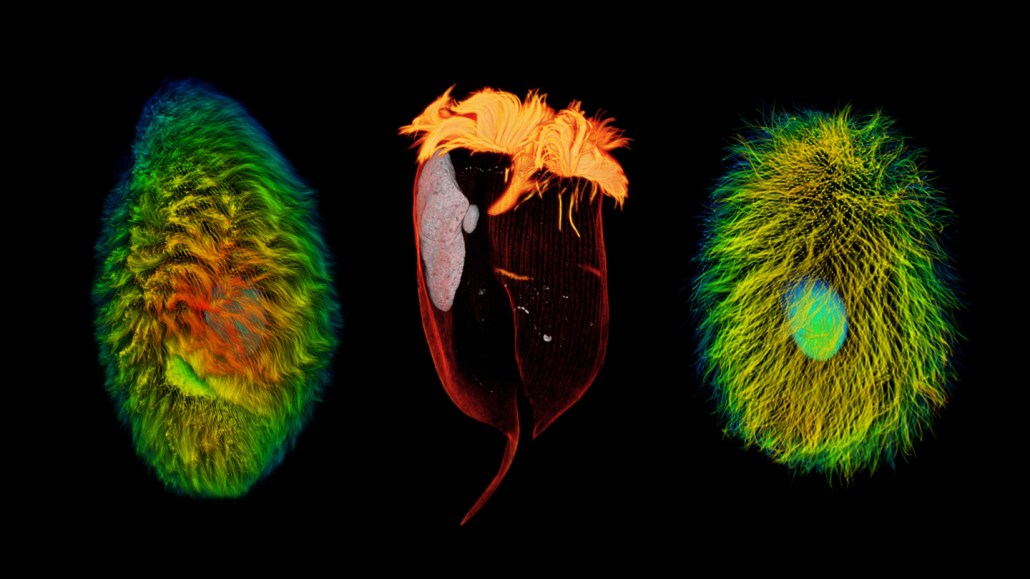
The stomachs of cows contain microbes that help break down plants. Single-celled ciliates make up about one-fourth of those microbes. Scientists have cataloged 65 ciliate species. They include Isotricha prostoma (left), Entodinium caudatum (center) and Dasytricha ruminantium (right). These 3-D microscope images show them in false color.
Chuanqi Jiang, Jinying He, and Che Hu/Institute of Hydrobiology/Chinese Academy of Sciences
This is a human-written story voiced by AI. Got feedback? Take our survey . (See our AI policy here .)
Cows belch a lot of methane, a potent greenhouse gas. But it’s not their fault. Scientists have identified a new trigger for the process. It resides in some microbes that live in the cows’ guts.
This tiny organelle appears to help control how much of this greenhouse gas the cows burp out.
Some 30 percent of methane produced by farming comes from cud-chewing animals, or ruminants. These include cattle, sheep, goats and deer.
Like organs in the body, a cell’s organelles perform specific roles. The new organelle was found in fuzzy, single-celled ciliates (SIL-ee-ets). These microbes belong to a group known as protozoa.
Ciliates get their name from the hairlike structures — cilia — that help these cells move and sense their environment. These tiny furballs make up about one-fourth of all microbes living in the rumen. That’s the first stomach of cud-chewing animals. There, these microbes help break down grass and other plants.
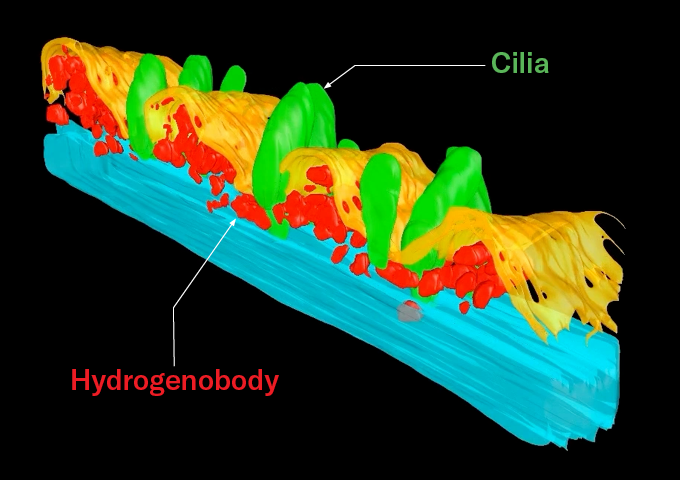
The new organelle makes hydrogen gas. So its discoverers are calling it a hydrogenobody (Hy-droh-GEN-uh-BAH-dee). The hydrogen it spews causes still other microbes in the rumen to produce methane.
To date, ciliates haven’t been studied much, says Ivan Čepička. He works at Charles University in Prague in the Czech Republic. He did not take part in the new research, but does study microbes, including protozoa.
Researchers in China have now cataloged DNA from ciliates found in ruminants. They’ve turned up 65 species, 45 never before identified.
These new species fell into three major groups. One type, Vestibuliferida, look like microscopic Koosh balls. Entodiniomorphida’s cilia develop appear like a shock of hair coming out of just one part of their cell. The third type of these microbes remains an unclassified family.
Tiny microbes, big impact
Some organisms that make hydrogen can prompt other microbes — archaea (Ar-KEE-uh) — to make methane. But those hydrogen-makers usually have organelles called hydrogenosomes (Hy-droh-GEN-uh-soams). They’re related to another organelle that makes energy.
But hydrogenosomes had not shown up in ciliates. So how rumen ciliates made hydrogen had been a mystery, Čepička says. The new study seems to have solved it: That gas comes from the hydrogenobodies. They’re located at the base of the structures that make ciliates look so fuzzy.
Researchers at the Chinese Academy of Sciences in Wuhan and several Chinese universities reported the surprising finding April 30 in Science.
The group had studied 100 dairy cows. The more ciliates these cattle had, the more methane-producing archaea they had. And the more methane-making archaea present, the more methane the cows belched.
Among ciliates, the Vestibuliferida are especially furry and have more hydrogenobodies. They also spew more methane than Entodiniomorphida.
What’s next?
One way to cut the methane in cow burps might be to remove Vestibuliferida from their rumen, the team suggests. It might also be possible to just curb the microbes’ growth.
People have tried to wipe out ciliates from the rumen, notes Todd Callaway. When they did, he adds, they saw a drop in how much methane cows make. But there was a downside, he adds: Cows with fewer ciliates produced less milk and meat. Callaway is a microbiologist and ruminant nutritionist. He works at the University of Georgia in Athens.
Keeping protozoa out of the rumen is hard, Callaway says. Cattle must be isolated in sealed barns. Their feed must be microbe-free. And they need to be kept at least 200 meters (660 feet) from other cattle. At that distance, the ciliates would no longer spread between cattle through the air.
Learning more about ciliates might lead to techniques that cut a cow’s methane burps while keeping her milk and muscle (meat) levels high.
Any such treatments are still a long way off, Callaway says. “This is step one of probably 25. But it’s a good step.”