astronomy: The area of science that deals with celestial objects, space and the physical universe. People who work in this field are called astronomers.
atmosphere: The envelope of gases surrounding Earth, another planet or a moon.
comet: A celestial object consisting of a nucleus of ice and dust. When a comet passes near the sun, gas and dust vaporize off the comet’s surface, creating its trailing “tail.”
eclipse: This occurs when two celestial bodies line up in space so that one totally or partially obscures the other. In a solar eclipse, the sun, moon and Earth line up in that order. The moon casts its shadow on the Earth. From Earth, it looks like the moon is blocking out the sun. In a lunar eclipse, the three bodies line up in a different order — sun, Earth, moon — and the Earth casts its shadow on the moon, turning the moon a deep red.
Grand Canyon: A natural canyon in northwest Arizona that formed as the Colorado River cut through the rock here over the past 5 million to 6 million years. This is one of many canyons on the river, which drains water from seven states. The Grand Canyon is 446 kilometers (277 miles) long. Its depth varies. At its deepest point, the river is 1,829 vertical meters (6,000 feet) below the upper rim. From rim to rim, the canyon’s width also varies — from about 16 kilometers (10 miles) to 29 kilometers. Of this impressive national land formation, more than a million acres (4,931 square kilometers, to be exact) was turned into a U.S. national park in 1919.
gravity: The force that attracts anything with mass, or bulk, toward any other thing with mass. The more mass that something has, the greater its gravity.
Neptune: The farthest giant planet from the sun in our solar system. It is the fourth largest planet in the solar system.
network: A group of interconnected people or things.
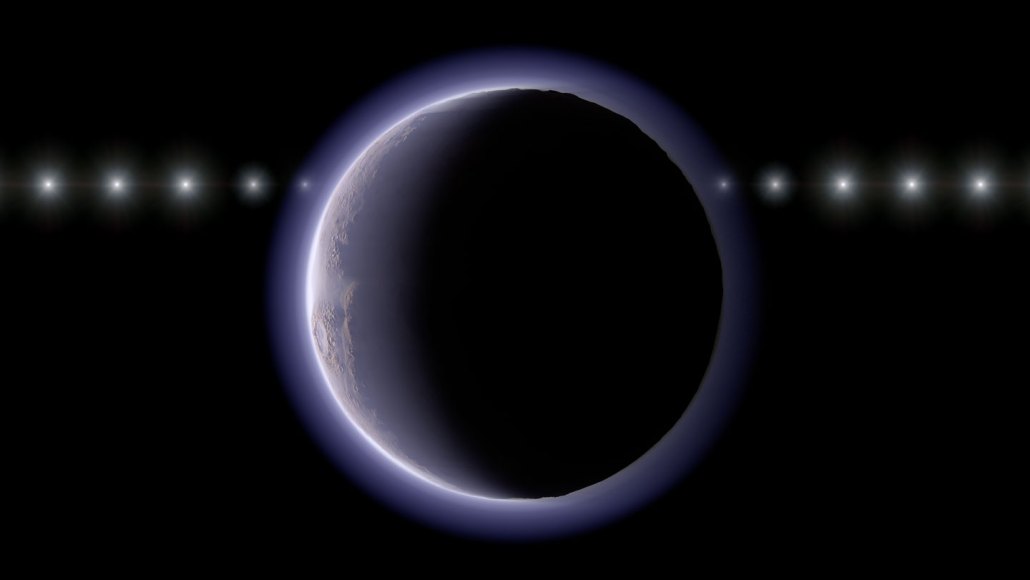
occultation: A celestial eclipse-like event in which an object that appears large from Earth, such as the moon, obscures a smaller-seeming object, such as a distant star.
observatory: (in astronomy) The building or structure (such as a satellite) that houses one or more telescopes. Or it can be a system of structures that make up a telescope complex.
Pluto: A distant world that is located in the Kuiper Belt, just beyond Neptune. Known as a dwarf planet, Pluto is the ninth largest object orbiting our sun.
pressure: Force applied uniformly over a surface, measured as force per unit of area.
scenario: A possible (or likely) sequence of events and how they might play out.
solar system: The eight major planets and their moons in orbit around our sun, together with smaller bodies in the form of dwarf planets, asteroids, meteoroids and comets.
star: The basic building block from which galaxies are made. Stars develop when gravity compacts clouds of gas. When they become hot enough, stars will emit light and other forms of electromagnetic radiation. The sun is our closest star.
sun: The star at the center of Earth’s solar system. It is about 27,000 light-years from the center of the Milky Way galaxy. Also a term for any sunlike star.
telescope: Usually a light-collecting instrument that makes distant objects appear nearer through the use of lenses or a combination of curved mirrors and lenses. Some, however, collect radio emissions (energy from a different portion of the electromagnetic spectrum) through a network of antennas.
volcano: A place on the crust of Earth (or another planet) that opens, allowing magma and gases to spew out from underground reservoirs of molten material. The magma rises through a system of pipes or channels, sometimes spending time in chambers where it bubbles with gas and undergoes chemical transformations. The surface around a volcano’s opening can grow into a mound or cone shape as successive eruptions send more lava onto the surface, where it cools into hard rock.