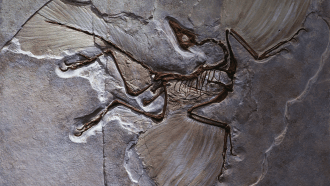
ancestor: A predecessor. It could be a family forebear, such as a parent, grandparent or great-great-great grandparent. Or it could be a species, genus, family or other order of organisms from which some later one evolved. For instance, ancient dinosaurs are the ancestors of today's birds. (antonym: descendant)
archaea: (singular: archaeon) One of the three domains of life on Earth. This group consists of single-celled prokaryotes — organisms without a cell nucleus. Archaea are best known for living in extremely harsh environments, such as very salty water or highly acidic or hot places.
bacteria: (singular: bacterium) Single-celled organisms. These dwell nearly everywhere on Earth, from the bottom of the sea to inside other living organisms (such as plants and animals). Bacteria are one of the three domains of life on Earth.
biologist: A scientist involved in the study of living things.
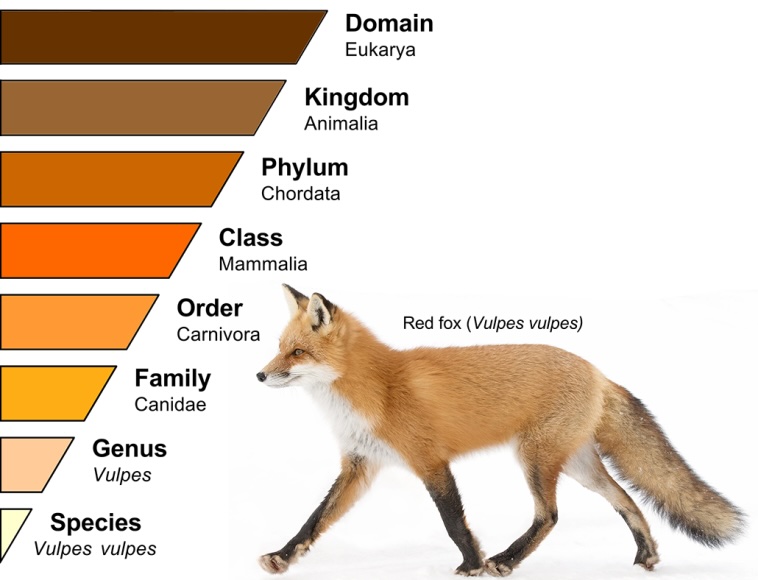
class: (in taxonomy) A ranking used to group similar organisms. It comes below phylum and just above order in the hierarchy (which ranges in descending order from domain to kingdom, phylum, class, order, family, genus and finally species. Members within a class share more traits with each other than with species in other classes within their phylum.
common ancestor: Also known as shared ancestor. It's an ancestor that two or more descendants have in common. Two siblings share a parent as a common ancestor. This also applies on the level of species and groups of organisms. Two or more species can share a common ancestor at the genus level. Two or more genera can share a common ancestor at the family level, and so on. Tigers and lions have a common ancestor, as do humans and Neandertals.
develop: To emerge or to make come into being, either naturally or through human intervention, such as by manufacturing.
DNA: (short for deoxyribonucleic acid) A long, double-stranded and spiral-shaped molecule inside most living cells that carries genetic instructions. It is built on a backbone of phosphorus, oxygen, and carbon atoms. In all living things, from plants and animals to microbes, these instructions tell cells which molecules to make.
domain: An area or territory ruled by a political power; an area of knowledge or influence. (in math) The values that go into a function. (in biology) The highest taxonomic rank of organisms, above that of kingdom.
extinct: (n. extinction) An adjective that describes a species for which there are no living members.
family: A taxonomic group consisting of at least one genus of organisms.
field: An area of study, as in: Her field of research is biology.
genus: (plural: genera) A group of closely related species. For example, the genus Canis — which is Latin for “dog” — includes all domestic breeds of dog and their closest wild relatives, including wolves, coyotes, jackals and dingoes.
Homo: A genus of species that includes modern humans (Homo sapiens). All had large brains and used tools. This genus is believed to have first evolved in Africa and over time evolved and radiated throughout the rest of the world.
Homo erectus: An extinct species of hominid that lived in Africa and Eurasia between about 1.9 million and 70,000 years ago.
Neandertal: A species (Homo neanderthalensis) that lived in Europe and parts of Asia from about 200,000 years ago to roughly 28,000 years ago.
order: (in biology) It is that place on the tree of life directly above species, genus and family.
phylum: (plural: phyla) A scientific term for a related group of living things. The modern animal kingdom includes about 35 phyla.
physical: (adj.) A term for things that exist in the real world, as opposed to in memories or the imagination. It can also refer to properties of materials that are due to their size and non-chemical interactions (such as when one block slams with force into another). (in biology and medicine) The term can refer to the body, as in a physical exam or physical activity.
species: A group of similar organisms capable of producing offspring that can survive and reproduce.
system: A network of parts that together work to achieve some function. For instance, the blood, vessels and heart are primary components of the human body's circulatory system. Similarly, trains, platforms, tracks, roadway signals and overpasses are among the potential components of a nation's railway system. System can even be applied to the processes or ideas that are part of some method or ordered set of procedures for getting a task done.
taxa: (sing. taxon) The groupings that distinguish organisms and their relatedness to each other. Most biologists order these groupings in ascending rank, going from species, to genus and family, then up through order, class, phylum, kingdom and domain.
taxonomy: The study of organisms and how they relate or have branched off (over evolutionary time) from earlier organisms. Often the classification of where plants, animals or other organisms fit within the Tree of Life will be based on such features as how their structures are formed, where they live (in air or soil or water) or where they get their nutrients. Scientists who work in this field are known as taxonomists.
technology: The application of scientific knowledge for practical purposes, or the devices, processes and systems that result from those efforts.
trait: A characteristic feature of something. (in genetics) A quality or characteristic that can be inherited.
tree of life: A diagram that uses a branched, treelike structure to show how organisms relate to one another. Outer, twiglike, branches represent species alive today. Ancestors of today’s species will lie on thicker limbs, ones closer to the trunk.