Analyze This: Which cells are the speediest?
Cells move fast by jumping, gliding, swimming and even expanding like a balloon
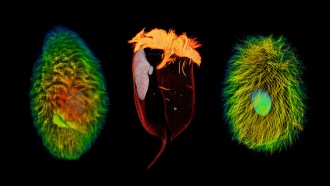
Tiny freshwater creatures known as hydra (one pictured) possess stinging cells that swiftly shoot out a threadlike structure.
Roland Birke Fotodesign/DigitalVision/Getty Images Plus
Life in the fast lane may call to mind sprinting cheetahs and diving falcons. But there are plenty of speed demons barely visible to the naked eye. Some of the fastest living things on Earth are cells. If these cells competed in their own Olympics, who would win? Scientists have now worked out how some of the world’s smallest swimmers, sprinters and jumpers would stack up.
Competitors in the cellular Olympics wouldn’t show up dressed in their uniforms and ready to compete, says Manu Prakash. He’s a bioengineer and oceanographer at Stanford University in California. “We have to go search in puddles and ponds around the world and in the deep ocean,” he says. To compare the cells, his team collected speed data on some. They reviewed past data that scientists had gathered on others.
Some swift cells jump or glide across water. Others flail whiplike threads called flagella or swim with the help of hairlike cilia. Then there are the speedsters that don’t change position but shrink or expand.
In some cases, a cell that’s part of a larger organism makes a rapid move. That includes the stinging cells of freshwater hydra, which fire off toxins in a single shot. Other times, single-celled life forms move in a flash.

On a trip to Liberia, in West Africa, Prakash saw countless specks of white in a pond. They were distributed in a peculiar pattern. “It could not have been random,” he says. He scooped out a sample and found Spirostomum, a type of single-celled organism. It can shrink its body faster than other eukaryotes — organisms whose cells wrap up their DNA in a nucleus. Speedy shrinking is part of Spirostomum’s communication, Prakash says. “It actually talks to other cells, we discovered later, using sound underwater.”
Or take Pyrocystis. These algae don’t swim and yet they make a massive migration. Prakash found these cells deep in the ocean off the coast of Hawai’i. At first, it didn’t make any sense because these cells need sunlight for photosynthesis. But Prakash and his team realized that the algae could inflate — ballooning to five times their original size — and deflate. That allows the cells to travel a kilometer (0.62 mile) from the depths to sunlit water.
Relative to the cells’ size, that’s the longest migration on the planet, Prakash says. He and teammate Ray Chang shared their comparison of ultrafast cells October 2025 in the Annual Review of Microbiology.
Prakash has found many fast cells as he’s searched for life in extreme conditions. These outlier organisms push our understanding of how life works. “This planet is filled with absurdities,” he says. “When you’re able to compare these things, you are able to understand the degree of absurdity.” And that, he says, highlights how some very special lifeforms have evolved.
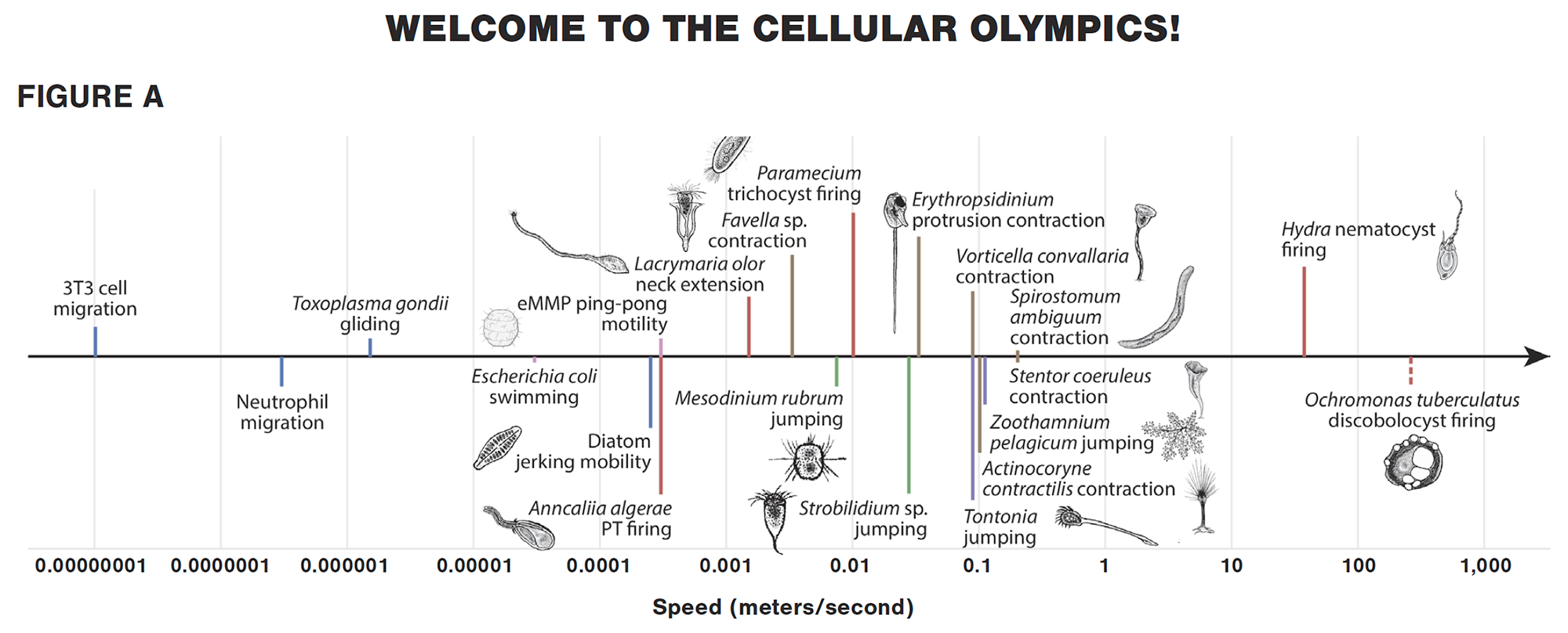
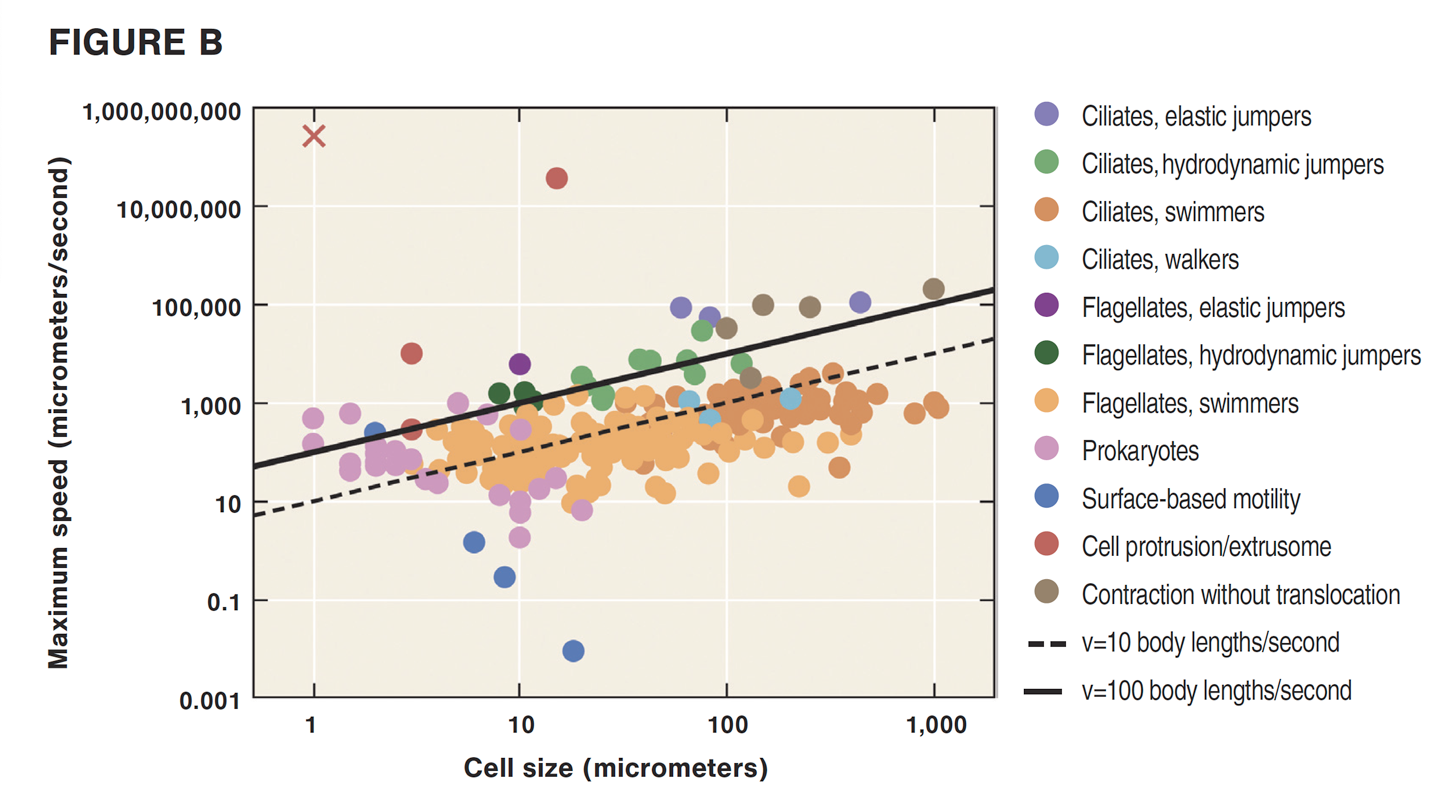
Figure A shows the speeds of some of the fastest cells known and how they move. Figure B shows different cells’ size (x-axis) and maximum speed (y-axis).
Ciliates move using hairlike structures called cilia. Flagellates move using whiplike structures called flagella. They make many of the same types of moves, including swimming, walking, elastic jumping (movements by contracting cilia or flagella) or hydrodynamic jumping (using cilia or flagella to leap forward).
Prokaryotes include bacteria and archaea. Surface-based motility means that a cell moves along a surface. Cell protrusion or extrusome is when something pops out of a cell. And contraction without translocation means that the size of the cell changes but the whole cell’s position doesn’t.
Cells above the dashed line in Figure B move more than 10 body lengths per second. Cells above the solid line move faster than 100 body lengths per second.
Data Dive:
- What is the fastest cell shown in Figure A? What is its speed?
- What is the fastest swimming cell? What is the fastest contracting cell?
- Look at Figure B. How do elastic jumping ciliates compare with swimming ciliates?
- What is the distribution — or spread — of speeds for prokaryotes?
- Ultrafast cells appear above the solid line marking 100 body lengths per second. What are the most common types of ultrafast cells?
- The “x” shows an estimate of a speed for a projectile fired off from Ochromonas tuberculatus. How fast does it move in body lengths per second?