Questions for ‘35 years on, Hubble continues to revolutionize astronomy’ 
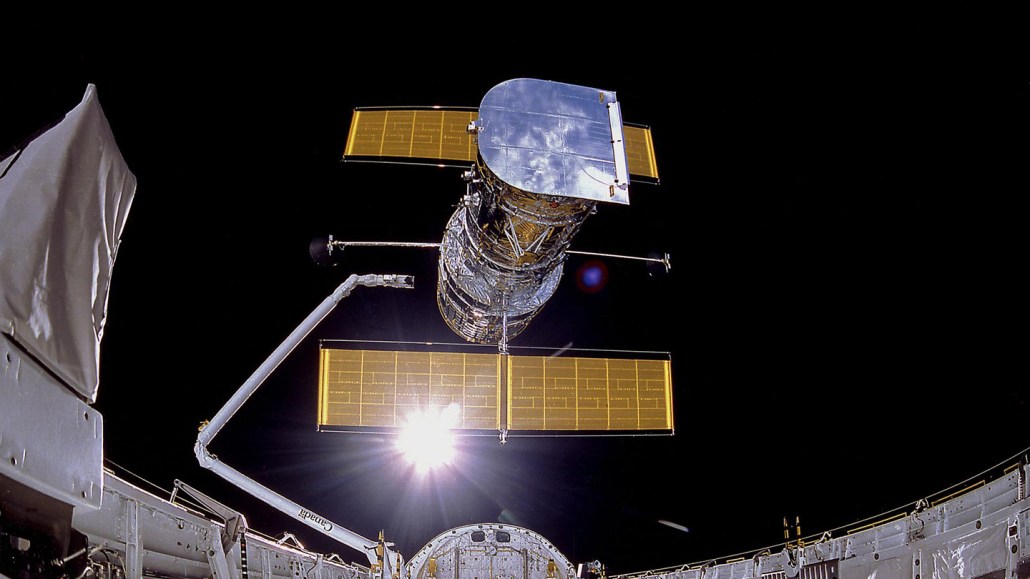
The Hubble Space Telescope being deployed from a space shuttle into orbit, with solar panels extended against the black backdrop of space and the sun shining brightly behind the observatory.

The Hubble Space Telescope was launched into low Earth orbit in 1990 from the space shuttle Discovery.

NASA, Smithsonian Institution, Lockheed Corporation

To accompany 35 years on, Hubble continues to revolutionize astronomy

SCIENCE

Before Reading:

  1. Consider the value of space telescopes to humans. Give three examples of general questions that space telescopes help us answer. Do you believe space telescopes are very important, moderately important or unimportant to humans? Explain your answer.
  2. Most of the light in the universe is invisible to humans. For example, we cannot see ultraviolet, or UV, light with the naked eye. How important is it to try to “see” this invisible part of the universe? Explain your answer.

During Reading:

  1. Which space shuttle launched the Hubble Space Telescope? In what year did that launch occur?
  2. Approximately how far from Earth’s surface does Hubble orbit?
  3. Describe one major advantage Hubble has over Earth-based telescopes.
  4. What is the scientific value of detecting ultraviolet, or UV, light?
  5. Besides UV, what other ranges of light does Hubble detect?
  6. Describe the 1994 event photographed by Hubble that inspired Peter Senchyna to study astronomy.
  7. What unusual feature of object P/2010 A2 caused astronomers to take a closer look?
  8. What do some scientists speculate is the cause for the Jewel Bug nebula’s unusual patterns?
  9. What is the significance of turbulent gas motion within the galaxy called NGC 4826?
  10. What sets NGC 1850 apart from other star clusters of its kind?

After Reading:

  1. Which of the Hubble images described in this story is your favorite to look at? Describe what you like about this image. Which of the images did you most enjoy reading about? Explain your answer.
  2. In 1995, Hubble imaged the “Hubble Deep Field.” This bit of space appeared empty to the naked eye. Explain what astounded astronomers about this image. How might an astronomer’s outlook on the cosmos change by seeing this image?
  3. Name one kind of light detected by the James Webb Space Telescope (JWST) that the Hubble does not detect so well. (Feel free to do a quick internet search.) How do the kinds of questions the JWST can answer differ from those Hubble can answer? Explain your answer.