The sweet truth about carbohydrates
Some people worry about eating carbs. But these starches and sugars give our bodies energy
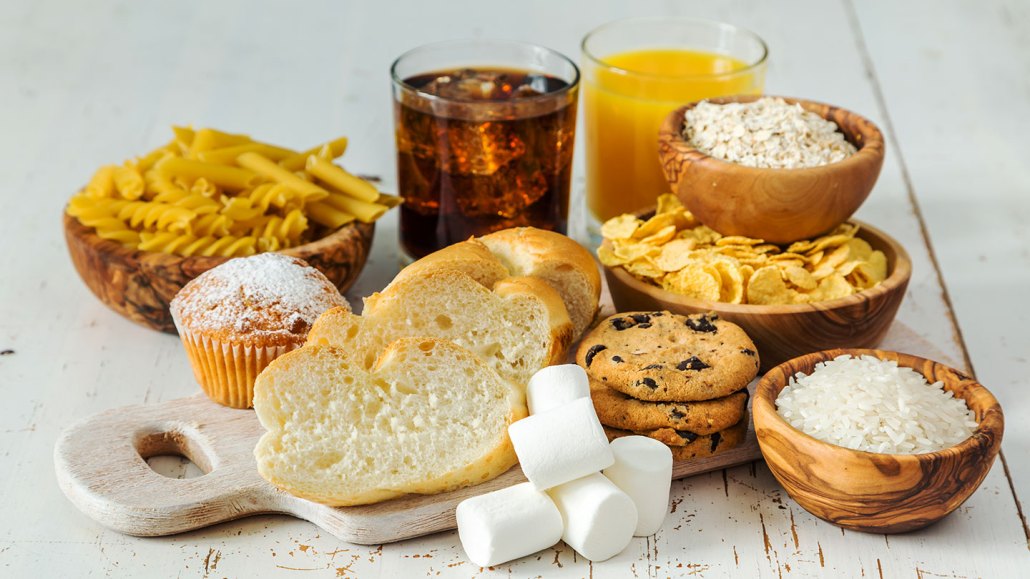
Carbohydrates are found in many foods we eat every day, including breads, pasta, grains and sweets such as soda and candy. Although it’s possible to live without consuming any carbohydrates, these nutrients are an important source of energy for our bodies.
a_namenko/iStock/Getty Images Plus
Ever seen the guy online who eats raw liver? What about the podcast by the guy who only eats meat and a little spinach? Unlike tigers or sharks, people aren’t carnivores. But you’d never know that if you went on social media.
A lot of influencers on social media and podcasts promote diets with as much protein — and as few carbohydrates — as possible. Some diet influencers talk about carbohydrate-rich foods, such as potatoes and bread, as though they’re poison, not a source of nutrients.
Even the U.S. government has gotten on the low-carb bandwagon.
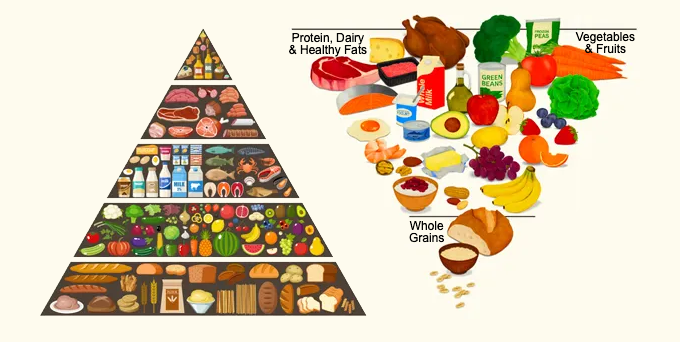
For more than 100 years, government agencies have helped people decide which foods to eat. Past guidelines often looked like a pyramid. The biggest section at the bottom — the foundation — comprised those foods that people should eat the most.
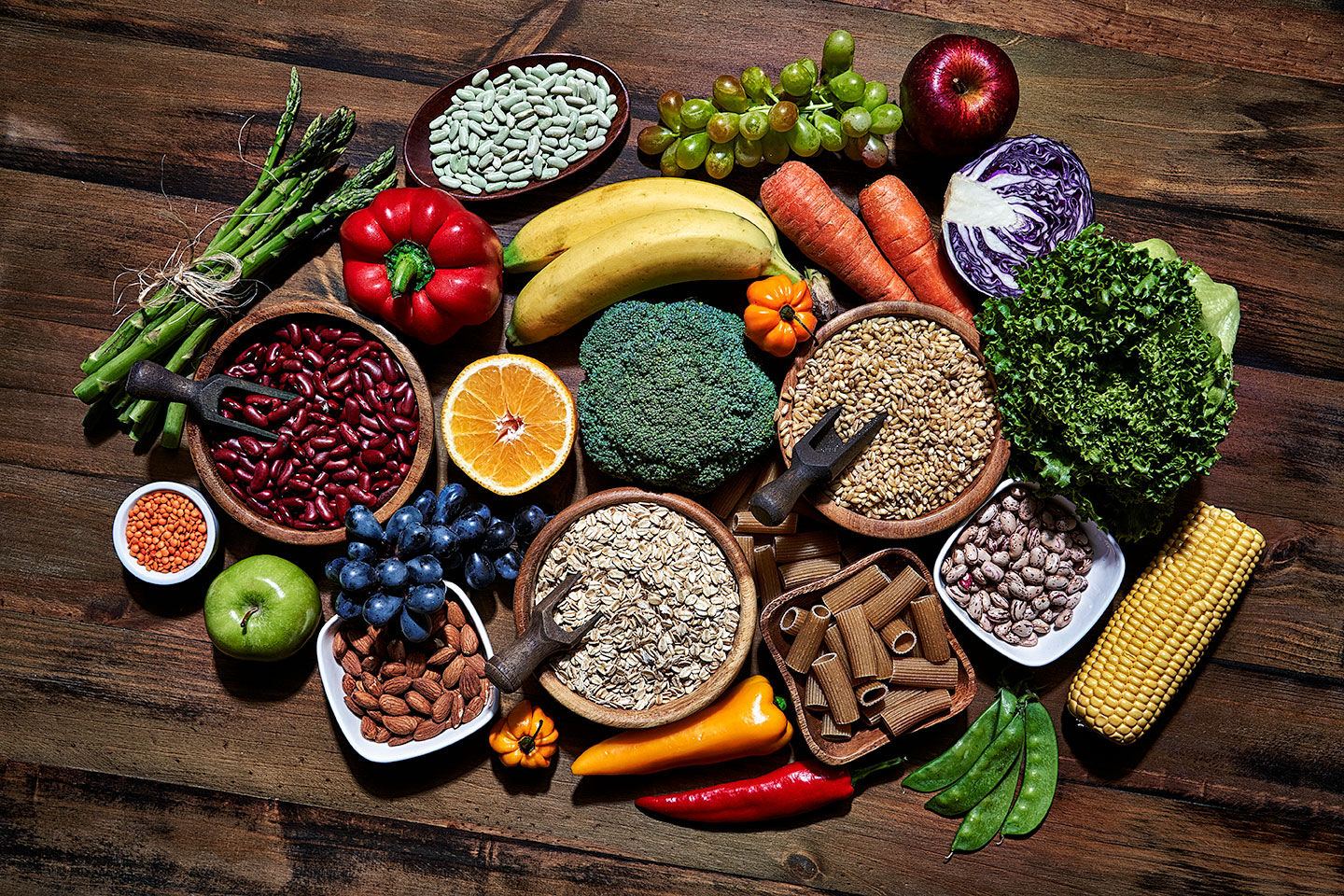
These images and guidelines changed over time as scientists learned more about how our bodies respond to food. But until 2026, the guidelines always promoted eating lots of bread, rice, cereals, fruits and veggies. These foods all have one important thing in common: carbohydrates. These foods are high in sugars, starch and fiber.
The latest food guidelines have now turned that pyramid upside down, literally.
In January, the U.S. government released its new version. The food pyramid now points downward, and carbohydrates make up just its tip. The image, and accompanying guidelines, suggest that people shouldn’t eat many carbs.
Scientists and doctors have worried that too many sugary treats can promote weight gain and poor health. And carbohydrates tend to be a big component of cookies, candy and soft drinks. Based on that, some people trying to promote health will suggest we eat as few carbohydrates as possible. There are even people who try to eat mostly meat and fats — and go on social media trying to get others to do the same.
But carbohydrates aren’t evil. Often, they’re exactly the burst of energy our bodies need.
Carbs come in many different types. Some provide quick energy for our brains and muscles. Others feed our gut bacteria or help us poop. Too many carbohydrates from sugars can be harmful in the long run. But cutting them from our diet isn’t the answer. Carbs can be an important — and delicious — part of healthful eating.
How to build carbohydrates
All living cells contain carbs. The word “carbohydrate” points to what these molecules are made of: a mix of carbon, hydrogen and oxygen atoms. (Carbo refers to carbon. Hydrate points to their hydrogen and oxygen atoms.) Which carbohydrate they are will depend on how many atoms come from each element and how they are arranged.
Every carbohydrate is built from sugar units called saccharides (SAK-uh-rydes). The smallest building block — a monosaccharide (MON-oh-sak-uh-ryde) — denotes that it has just one saccharide.
Glucose is a monosaccharide. Its chemical formula — C6H12O6 — denotes that it has 6 carbon atoms, 12 hydrogens and 6 oxygen atoms. This molecule is important to health. It provides energy for our cells, including our muscles and brain. The term blood sugar refers to the amount of this glucose circulating in our blood.
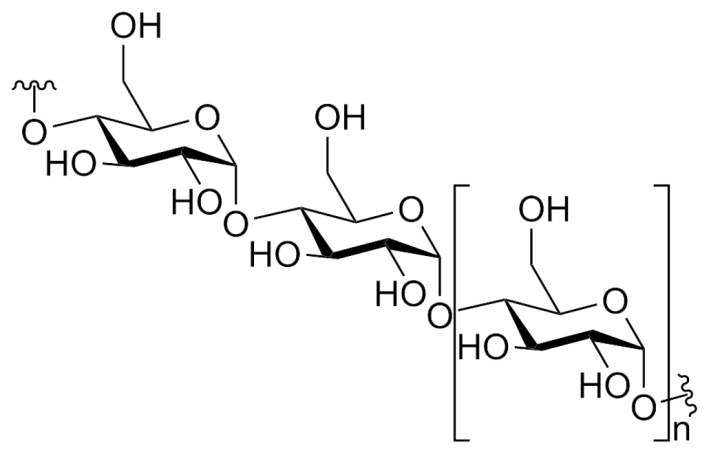
Amylose
This is a chemical drawing of amylose, a type of starch that is a long chain of glucose molecules linked together. The brackets indicate a single glucose unit. The “n” at the bottom right corner is to show that there could be many more glucose molecules.
Other monosaccharides your body might encounter include fructose (FROOK-tose), galactose (gah-LACK-tose) and xylose (ZY-lose).
Sucrose, sometimes called table sugar, sweetens a lot of candy and baked goods. It’s a disaccharide (die-SAK-uh-ryde), meaning made of two sugar units — in this case, a glucose hooked onto a fructose molecule.
Then there are the polysaccharides. These “are usually long chains of multiple glucose molecules joined together,” explains Michael Gleeson. He’s a sport nutritionist at Loughborough University in England.
Glycogen
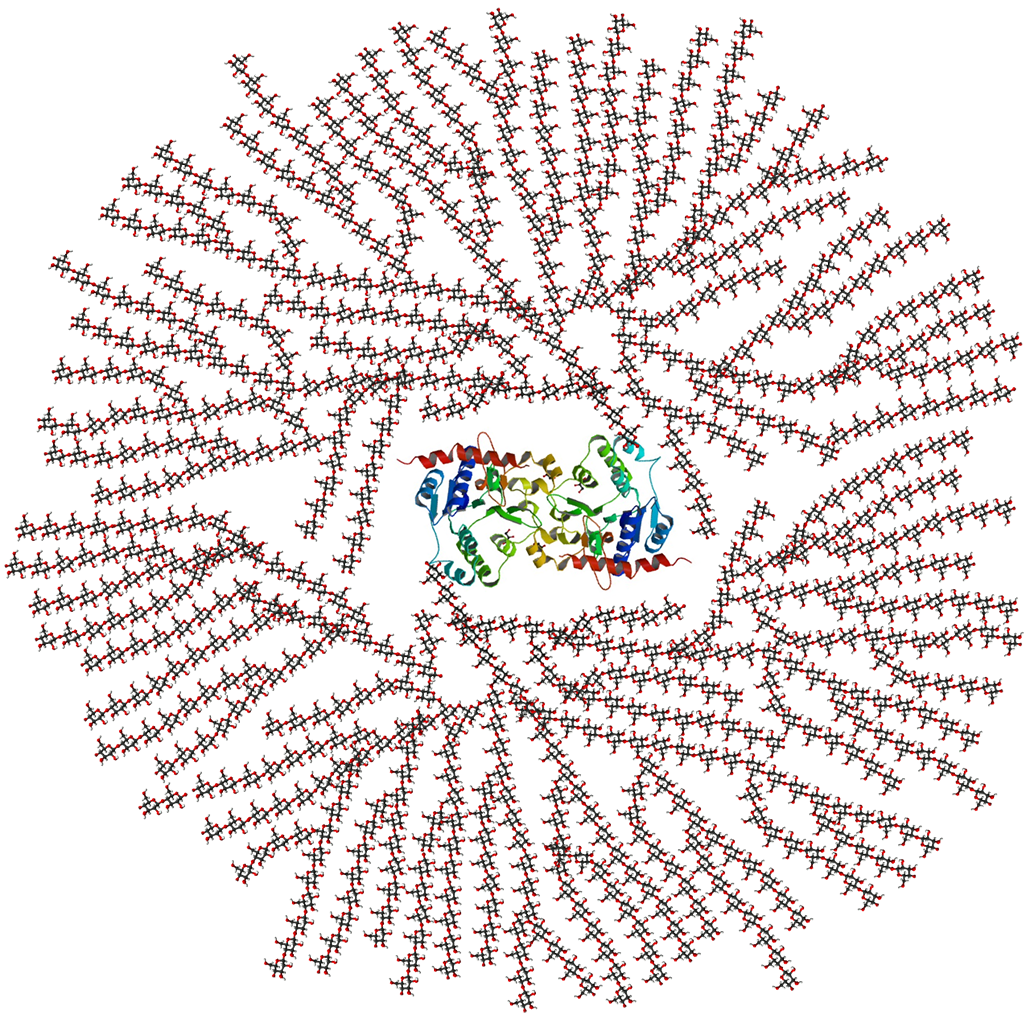
This is a chemical drawing of glycogen, a carbohydrate molecule that our bodies use to store glucose. The long chains here are made up of glucose molecules waiting to be used.
Although there are many types of polysaccharides, our bodies encounter three most often. One is glycogen. Animals use this molecule to store sugars as energy. “We find that in our muscles and our liver,” Gleeson says. The second, or starch, is “a storage form of energy in plants,” he explains. The third type is fiber, which our bodies can’t turn into energy.
When scientists talk about carbohydrates in food, they call monosaccharides and disaccharides “simple” sugars. These are common in processed foods. Polysaccharides such as starch are “complex” carbohydrates and more commonly turn up in less-processed foods, explains Kimber Stanhope. She’s a nutrition researcher at the University of California, Davis. “Rice and wheat and oats and corn — those foods are mostly starch,” she notes.
From food to fuel
Foods we classify as “carb-rich” often contain a mix of different carbohydrate molecules. For example, a cookie will have plenty of sucrose. But it also has flour, which contains starch. Whole-wheat bread will have starch and some sugar, as well as fiber. Vegetables, such as carrots, are made of cells that contain starch, sugars and fiber.
Our bodies can use glucose molecules right away. Other carbohydrate molecules must first be broken down.
Complex carbohydrates “are relatively large molecules,” Gleeson explains. The gut can’t directly absorb them. They must be digested — their polysaccharide chains broken apart — to release their glucose units.
That digestion starts in the mouth, Gleeson explains. Saliva contains enzymes — molecules that speed up chemical reactions. “Your spit contains some enzymes, which break down the long-chain carbohydrates into disaccharide units,” he says. Those much simpler sugars head to the stomach. But, he adds, little carbohydrate digestion goes on there. Why? “The enzymes that are coming [in with] the saliva,” he explains, “are inactivated by [stomach] acid.”
After the stomach, “you’ve mixed everything up into a nice sort of soup-like consistency,” called chyme (KYME), Gleeson explains. “That’s sort of squirted, almost, into the small intestine. And there we secrete enzymes into the small intestine from the pancreas.”
Those enzymes finish the job, splitting disaccharides into monosaccharides such as glucose. Our blood then absorbs the glucose and moves it around the body.
When that blood reaches the liver, an enzyme grabs glucose from it. Called phosophofructokinase (FOS-foh-FROOK-toh-KY-nays), this enzyme links up the glucose molecules to form glycogen. Glycogen then gets stored in the liver, muscles and fat cells. The body will draw on it when it needs more energy.
This liver-enzyme reaction has turned carbs from food into a stored fuel. The liver turns off this enzyme when it determines that it has made enough glycogen.
Sugar’s not always sweet
The body aims to keep blood glucose levels fairly constant. So when cells draw down this sugar, the liver begins breaking down some stored glycogen, releasing its glucose into the blood.
That’s especially important during exercise, as your muscles burn through glucose to power activity.
It’s a different story for fructose. This monosaccharide pairs up with glucose to make sucrose. But it’s also found on its own in fruits, vegetables and honey. Manufacturers have also sweetened many sugary foods and drinks with this sugar in the form of high-fructose corn syrup.

In the liver, an enzyme called fructokinase (Frook-toh-KY-nase) sets off the first step in turning fructose into glycogen. But unlike the enzyme that processes glucose, fructokinase “doesn’t seem to get turned off — ever,” explains Stanhope at UC Davis.
So if you’re drinking a sugary soft drink, “86 percent of all the fructose you’re consuming in that … drink goes into the liver,” Stanhope says. “The liver does the best it can with all this fructose, but now it’s overloaded.” The liver will now turn any excess into fat, she explains.
Too much fat can hamper how the liver reacts to hormones such as insulin. As a result, the organ stores even more sugars as fat. “You just keep going around in circles and making the situation worse,” Stanhope explains.
That’s why eating too much fructose can be a problem. The issue isn’t fructose from fruits and vegetables, though. Consider a sweet fruit, such as grapes, Stanhope says. “They basically average around 16 percent of their weight as sugar.” But fruits and veggies also contain fiber and other complex carbohydrates, as well as vitamins and other nutrients.
Most of the sugar in our diet doesn’t come from fruit but from sweetened baked goods and drinks. Oreos, for instance, are 38 percent sugar, of which fructose is half.
Many sweets have even higher levels of fructose than that. Some highly processed foods — not only soda but also canned soups and some sauces — can contain a type of corn syrup that is 55 percent fructose (five percent more fructose than in table sugar), Stanhope says.
What really worries her are some corn syrups where the share of fructose is higher still. One 2014 study tested sodas and juices containing high-fructose corn syrup. Many of these drinks contained 60 percent fructose — some even close to 70 percent. That’s a lot for the liver to handle.
Too much sugar, not enough fiber
While our bodies can break down starches and sugars for energy, other carbohydrates are tougher. Consider fiber.
Fibers are polysaccharides found in plants. Our bodies cannot fully break these down. Fibers include the cellulose that makes plant cell walls stiff. They include the pectins (PEC-tins) that firm up fruits. You’ll find them in whole fruits, vegetables, beans and whole-grain products (such as whole-wheat bread).
Our bodies can’t convert fiber into energy. But our bodies still find it useful, notes Leslie Cho. A cardiologist, or heart specialist, she works at the Cleveland Clinic in Ohio.
Fiber comes in two types. Soluble fiber, as its name suggests, dissolves in water. This type shows up in foods such as apples, bananas, avocados, citrus fruits, carrots, beans and oats. By acting like a sponge, Cho says, “it helps you lower your cholesterol and glucose.”
Cholesterol (Ko-LES-ter-ol) is a fatty material that drifts in our blood. Over time, it can collect in blood vessels and increase someone’s risk of heart attack or stroke. By soaking up cholesterol, soluble fiber helps eliminate it.
That sponge-like fiber can also trap glucose so that it takes longer for those sugar molecules to enter the blood stream. If you eat a lot of sugar and no fiber, Cho explains, “you absorb glucose very quickly and you tend to get hungry again.” Soluble fiber keeps you feeling fuller longer. And it’s especially helpful for people with high blood sugar, such as those with type 2 diabetes.
The other fiber — the insoluble type — “doesn’t dissolve in water, and it helps you with your stomach and your intestine,” Cho says. Vegetables, whole-wheat bread, potatoes, beans, nuts and seeds all contain this type.
This fiber even helps you poop; it’s one of the ways your body takes out the trash. How? Insoluble fiber adds bulk and pulls water into your stool. That keeps you pooping just often enough for comfort.
Soluble and insoluble fibers also serve as an important food for the bacteria in your microbiome. Those are the bacteria that live in your gut, Gleeson explains. “They have a big influence on your immune system and on your health.”
Bacteria can break some fiber down into molecules that affect our immune and other systems. These bacteria “also produce chemicals that can communicate with the brain,” Gleeson says. In this way, “They influence your mood and your sleep.”
Most people eat too little fiber, Gleeson says. Diets with lots of simple sugars don’t have enough fiber to keep our microbes happy. We’re talking about meals that contain lots of white bread or rice, cookies and cakes — and too few fruits, vegetables, beans or whole grains.
Do you have a science question? We can help!
Submit your question here, and we might answer it an upcoming issue of Science News Explores
Carbohydrate controversy
Like proteins and fats, carbohydrates are an important macronutrient. But do people need them?
The body needs certain fatty acids and amino acids to build cells and operate effectively. That’s why we need to eat fats; they provide some essential fatty acids that our bodies can’t make, notes Gleeson. And, he adds, “Protein is absolutely essential, because there are [also] amino acids in those proteins” that we can’t make on our own.
But technically speaking, he says, you can live without eating carbohydrates.
Glucose is an essential fuel for the brain, Gleeson explains. Fortunately, the body can make it from fats, amino acids and water. Getting glucose this way wouldn’t be a very tasty life, though. And people who live on extremely low-carb diets can miss out on fiber, vitamins and other nutrients.
But for some carbs, reducing how much of them you eat isn’t a bad idea. We don’t need nearly as much sugar — especially soft drinks, candy or cake — as we eat, observes Stanhope at UC Davis.
“There is simply no doubt,” she says: “Evidence shows sugar is detrimental to our health when consumed at high levels.” The problem: “We just don’t know for sure how high ‘high’ is.”
Because of worries about too much sugar, some people try diets with as few carbohydrates in them as they can manage — eating mostly meat and a few veggies. But such low-carb diets won’t necessarily result in a healthy body, Gleeson points out.
Living the low-carb life tends to be high in fats and protein. Long term, all that fat and protein can put people at risk for heart disease, type 2 diabetes and problems with their kidneys (the organs that produce urine). People on low-carb diets who don’t eat enough fiber also don’t poop enough, suffering constipation.

And if you’re an athlete, your body definitely needs carbs. Athletes perform their best with carbs, Gleeson has shown in his research. Complex and simple carbohydrates are the easy energy our bodies use to work hard.
“As soon as you start doing hard running, sprinting as fast as you can, performing any all-out efforts, then you’re going to be using carbohydrate,” he says.
“There is no food group that’s bad,” Cho adds. “You can’t eliminate one whole thing and think you’re doing a good job.” Although high doses of simple sugars can cause problems, other carbohydrates don’t. “We often [confuse] ‘good’ carbohydrates with ‘bad’ carbohydrates,” she notes. And unfortunately, that can give important nutrients a bad rap.
The trick is eating enough carbs — and a diverse mix of them — to give us energy and a great-tasting diet. Just don’t overdo it.
“Moderation is important, even though these things taste good,” Cho says. And much as cookies, soda and candy are delicious, they don’t contain fiber or other nutrients. “Instead of having five chocolate bars, maybe you can just have one.”