Analyze This: Spooky feelings may come from noises too low to hear
Infrasound was linked with finding music sad and higher levels of a stress marker in spit

Supposedly haunted locations may be full of noises too low-pitched to hear — from old pipes, air ducts and other structures. A new study hints that such infrasound noises may affect people’s moods in a negative way. And that might be part of the reason that “haunted” places feel so unsettling.
Chris Clor/Getty Images
This is a human-written story voiced by AI. Got feedback? Take our survey . (See our AI policy here .)
On haunted history tours, people often visit eerie theaters and spooky mansions. Such old buildings are often settings for spine-tingling stories. They may also hum with noise too low to hear, from old plumbing or air ducts. That unheard sound, called infrasound, might be one reason these places give people the creeps. A new study hints that even though people can’t hear infrasound, it may influence their mood.
Infrasound is noise with frequencies below 20 hertz — around the lower limit of what humans can hear, says Kale Scatterty. A behavioral neuroscientist, he works at the University of Alberta in Edmonton, Canada. Some natural sources, such as the rumblings of volcanoes and earthquakes, produce infrasound. Traffic, trains, air conditioning systems and other tech also make this low-pitched noise.
Humans and many animals can’t hear infrasound. But past studies have suggested that animals may detect it with their bodies — and that it might even provoke anxiety or fear. Scatterty’s team wondered if people could detect infrasound. Our ears contain otolith organs that help us perceive our movement and position. These organs might pick up on vibrations too low to hear.
Scatterty and his colleagues had 36 people listen to music. Half of them were exposed to infrasound while they listened. The others were not. The scientists then compared the two groups’ responses to the music.
People exposed to infrasound rated music as sadder than those who heard it without infrasound. This was true whether the music itself was calm or unsettling. The infrasound group also said the music was less interesting and reported being more irritable. Cortisol, a stress hormone, was higher in people’s saliva after they experienced infrasound. But people couldn’t seem to tell whether they were in the infrasound group.
The results suggest that infrasound does influence humans’ mood and biology. It seems to happen without people being conscious of it, Scatterty says. The team shared its findings April 27 in Frontiers in Behavioral Neuroscience.
Do you have a science question? We can help!
Submit your question here, and we might answer it an upcoming issue of Science News Explores
Infrasound might especially affect people and animals near urban environments, Scatterty says. Those places have transit, air conditioning systems and other infrastructure that creates such low-frequency noises. But it’s not clear what the long-term impacts of infrasound exposure might be.
Another open question is whether infrasound provokes fear, he says. In this study, the participants — college students — didn’t report feeling scared or anxious when exposed to infrasound. And the emotional changes the team did measure could have been responses to the study setup. “It could have very well just been that we were priming them to feel something,” Scatterty says. And the students might have felt irritable because they had other places to be.
But a spookier environment might help deepen the investigation. Scatterty and his colleagues have thought about studying infrasound in a haunted house set up for Halloween. “Maybe when you’re in a haunted house, yes, you would react more fearfully because you’re primed to be afraid of something.”
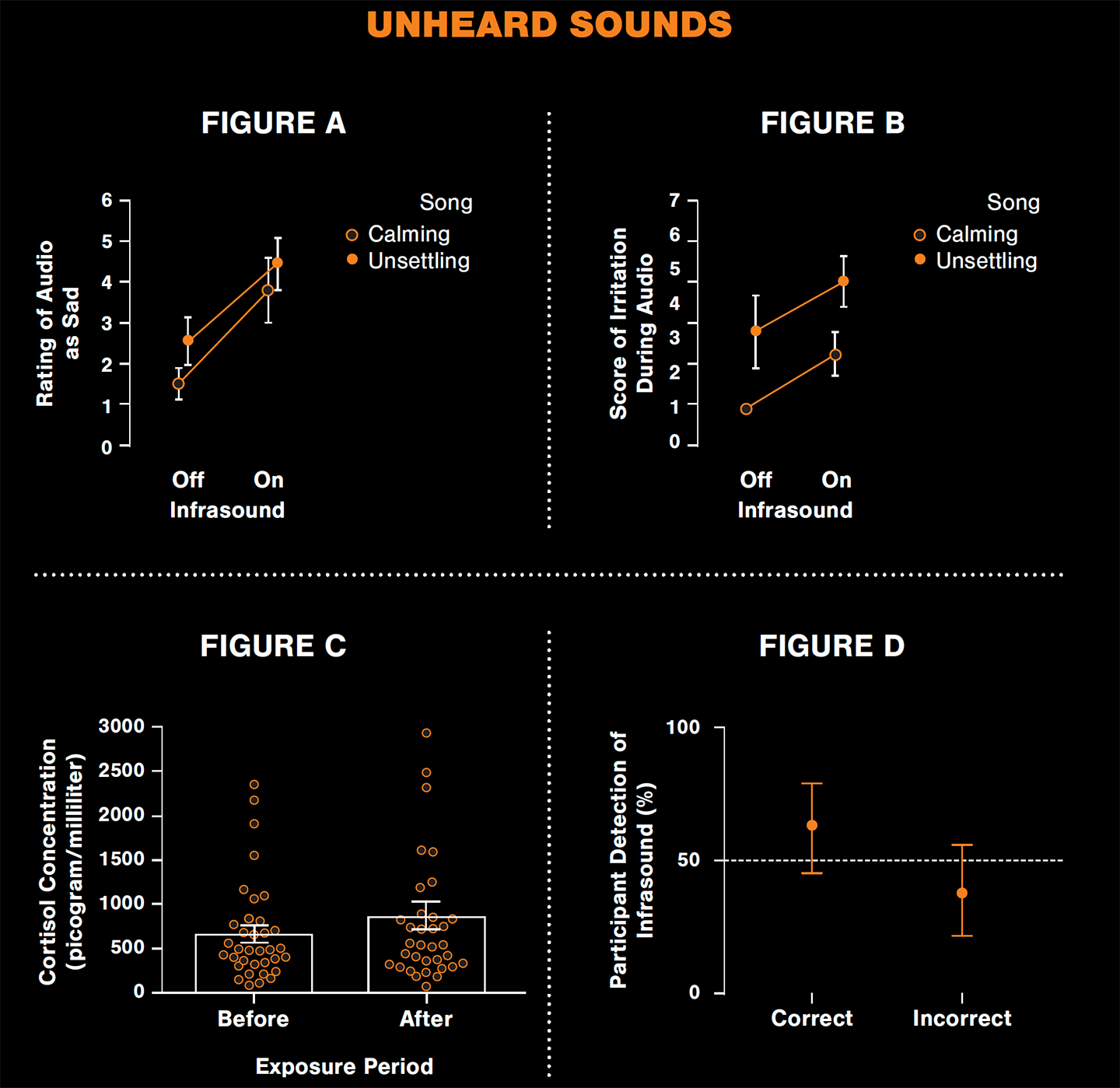
Researchers outfitted two rooms with speakers to play music. Outside of those rooms were two subwoofers — speakers that produce low sounds. In this study, they played infrasound.
The 36 study participants heard either a soothing song that might play at a spa or an eerie tune that would fit in a horror film. Half of the participants heard the music while infrasound played. The team then asked people how the music sounded and how it made them feel.
The researchers compared the answers of those who listened to music with the infrasound off and on (Figures A and B). They also sampled the study participants’ spit to study whether cortisol concentration — a marker of stress — was higher after infrasound exposure (Figure C shows individual measurements as dots and the averages as bars). After answering these questions, participants said whether they thought they had been exposed to infrasound (Figure D).
Data Dive:
- Look at Figure A. What was the average rating of the calming song as sad when infrasound was off? What about when infrasound was on?
- Look at Figure B. How irritated were people when infrasound was off versus when it was on?
- Look at Figure C. What was the average cortisol concentration in spit before people were exposed to infrasound? What was it after?
- Look at Figure D. What percent of participants correctly guessed whether they’d been exposed to infrasound? What percent were incorrect? How does this compare with what you’d expect if each person guessed by flipping a coin?
- Cortisol is a marker of stress. What is another event that might be linked to an increase in cortisol levels?