MS-ESS1-2
Develop and use a model to describe the role of gravity in the motions within galaxies and the solar system.
- Physics
Scientists discover likely source of the moon’s faint yellow tail
These sodium atoms are part of the debris kicked up from the moon’s surface, mostly by micrometeorites, two new studies conclude.
- Planets
Signs of a hidden Planet Nine in our solar system may be an illusion
Hints of the remote planet, also called Planet X, relied on clumped up orbits of bodies beyond Neptune. A new study suggests that clumping doesn’t exist.
- Space
Our feverish universe is getting hotter every day
For the first time, astronomers have taken the temperature of the cosmos at different times in its history. Galaxy clusters are cranking up the heat.
- Planets
Rogue planets wander the galaxy all alone
Some planets don’t orbit stars. They were kicked into space long ago. The newest, smallest one found is only about as massive as Earth.
- Math
Meet ‘Pi’ — a new Earth-sized planet
Searching through data from NASA’s K2 Mission, researchers found a new planet. Some call it K2-315b, others smile and refer to it as “Pi Earth.”
- Health & Medicine
Surviving Mars missions will take planning and lots of innovation
Astronauts that go to Mars will need protection from microgravity and radiation, plus mini-medical devices to diagnose problems and manage emergencies.
- Physics
Scientists Say: Gravity
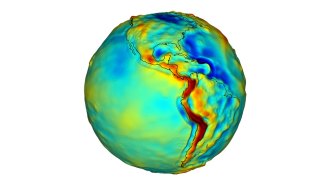
Gravity is a fundamental force that attracts objects with mass to other objects with mass. It decreases with distance.
- Physics
2020 Physics Nobel goes for delving into black holes
Although Einstein’s general theory of relative suggested black holes might exist, this year’s winner’s helped show they actually are out there.
- Physics
Strange but true: White dwarfs shrink as they gain mass
Telescope observations of thousands of these stars now confirm a decades-old theory on how their masses relate to their waistline.
- Physics
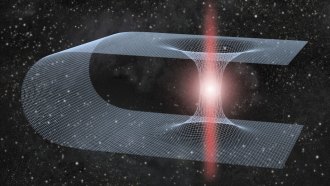
Could ripples in spacetime point to wormholes?
A new calculation reveals that strange gravitational waves detected by LIGO and Virgo could see if a black hole were falling into a hypothetical tunnel in spacetime.
- Physics
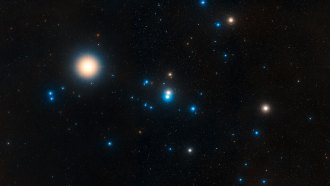
Milky Way’s tidal forces are shredding a nearby star cluster
The nearest star cluster is being pulled apart, due largely to the tidal forces of our galaxy, the Milky Way. Bye bye, Hyades!
- Physics
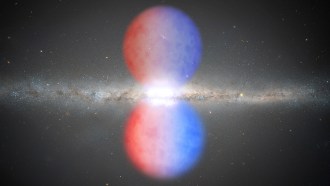
Spotted: Milky Way’s giant gas bubbles in visible light
The bubbles have different colors, based on how the gas inside them moves. That could give clues to how the bubbles developed.