MS-PS4-2
Develop and use a model to describe that waves are reflected, absorbed, or transmitted through various materials.
- Earth
News Brief: Why rainbows can lose some hues
When the sun is right near the horizon, such as at sunset, its light travels through the most atmosphere. When there’s also plenty of water in the air, this can rob colors from a rainbow, scientists now report.
- Physics
Boom! Sounding out the enemy
Armistice Day marked the end of the Great War. But what arguably won the war was acoustics — the science of sound. It allowed Allied troops to home in on and rout the enemy.
- Earth
Keeping roofs cooler to cut energy costs
Cool it! A cheap paint-on coating for roofing shingles could help reduce a home’s heating bills and might even trim urban ozone levels, a teen shows.
- Brain
Trip to Mars could damage astronauts’ brains
Experiments in mice suggest the high-energy particles that would zap astronauts on a mission to Mars could leave the explorers with brain damage.
- Chemistry
Cool Jobs: Saving precious objects
Museum conservators are experts at protecting and restoring precious objects. Along with art or history, many also have studied chemistry, physics, archaeology or other scientific fields.
- Archaeology
Laser vision reveals hidden worlds
From discovering ancient ruins to forecasting climate change, the laser mapping technology called lidar is changing many fields of science.
- Tech
Explainer: What are lidar, radar and sonar?
Radar, sonar and lidar and are three similar technologies. Each relies on the echoing of waves — radio, sound or light waves — to detect objects.
- Earth
Nepal earthquake offers hints of worse to come
The magnitude 7.8 earthquake that crumbled much of Nepal’s capital city could be overshadowed by larger future earthquakes along the Himalayas, scientists say.
- Space
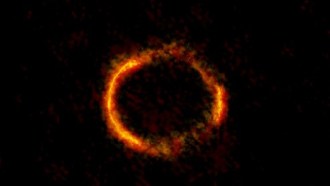
Scientists Say: Gravitational lens
A gravitational lens is an effect that occurs when a massive object lies between a viewer and something further away. The massive object’s gravity bends light arriving from the more distant object.
- Materials Science
Cool Jobs: Big future for super small science
Scientists using nanotechnology grow super-small but very useful tubes with walls no more than a few carbon atoms thick. Find out why as we meet three scientists behind this huge new movement in nanoscience.
- Space
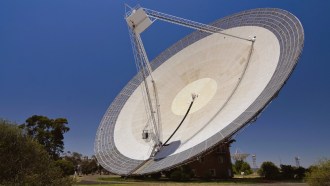
Radio telescope picks up signals from intelligent life
Astronomers tracked down the source of perytons, mysterious radio bursts. They had at first seemed to emanate from Earth’s atmosphere. Probing now suggests the life forms responsible had a penchant for leftovers.
- Animals
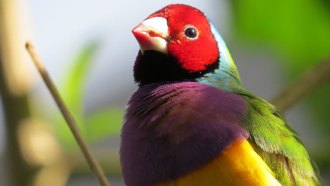
Mates or survival: Which explains a bird’s color?
When male birds are brightly colored, we assume that’s because their plumage attracts the gals. But a new study with thousands of museum specimens shows that sometimes survival is just as important a factor behind bird color.