Physics
- Animals
Quacks and toots help young honeybee queens avoid deadly duels
It’s not just ducks that quack. Honey bees do it too. They also toot. Researchers eavesdropped on hives to find out why.
- Materials Science
Will bacterial ‘wires’ one day power your phone?
An accidental discovery helps scientists generate electricity out of thin —but humid — air with bacteria-made protein nanowires.
- Physics
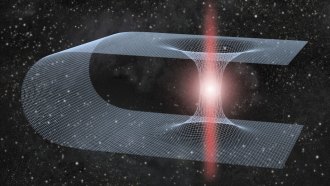
Could ripples in spacetime point to wormholes?
A new calculation reveals that strange gravitational waves detected by LIGO and Virgo could see if a black hole were falling into a hypothetical tunnel in spacetime.
- Physics
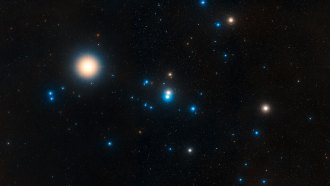
Milky Way’s tidal forces are shredding a nearby star cluster
The nearest star cluster is being pulled apart, due largely to the tidal forces of our galaxy, the Milky Way. Bye bye, Hyades!
- Physics
Explainer: Stars and their families
Most pinpoints that light the night sky are raging infernos we call stars. As adults, many will create new elements that they later cast off into the cosmos.
- Chemistry
Let’s learn about batteries
Many things in our lives rely on batteries. Here’s how scientists are working to make new ones — and make existing batteries safer.
- Animals
Flying snakes wriggle their way through the air
Flying snakes go tens of meters (yards) without wings. They do it by undulating back and forth and up and down, a new study shows.
- Physics
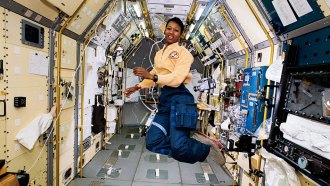
Scientists Say: Microgravity
Gravity is a force that brings objects together. But when those objects get far away, the force feels small. It feels like microgravity.
-
- Physics
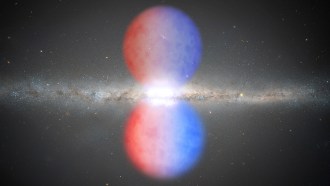
Spotted: Milky Way’s giant gas bubbles in visible light
The bubbles have different colors, based on how the gas inside them moves. That could give clues to how the bubbles developed.
- Brain
Explainer: How our eyes make sense of light
It takes a lot for images before the eyes to be 'seen.' It starts by special cells sensing the light, then signals relaying those data to the brain.
- Physics
Understanding light and other forms of energy on the move
Radiation needn’t be scary, especially if it allows us to see our family or use our cell phones. Here’s a guide to light and other types of emitted energy.