Physics
- Materials Science
Scientists Say: Crystal
The atoms or molecules in crystals take on a particular, repeatable pattern.
- Materials Science
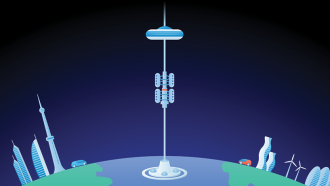
Could humans build a tall tower or giant rope to space?
The movie Ad Astra shows a space antenna, a spindly structure reaching up into the stars. We look at what it would take to build something that big.
- Animals
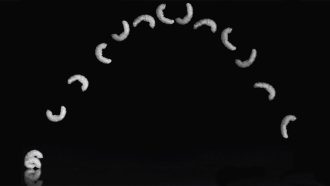
High-speed camera reveals the secrets of a legless larva’s leap
Research reveals how a blob of an insect can leap more efficiently than it crawls. Its body acts like a spring.
- Chemistry
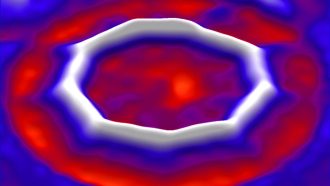
Chemists have created a ring-shaped form of carbon
A ring-shaped carbon molecule takes its place among buckyballs, carbon nanotubes and other odd forms of the element.
- Materials Science
High-tech crops may survive harsh conditions, even space
Scientists have developed a non-invasive method for integrating metal-organic frameworks into plant tissue. This lays the foundation for resilient crops that can weather harsh conditions.
- Physics
This idea would turn the Earth into a giant space telescope
One astronomer has a bold solution to getting around the high cost of building big telescopes.
- Earth
Americans consume some 70,000 microplastic particles a year
The average American consumes more than 70,000 microplastic particles a year. Scientists hope this estimate will spur others to look at health risks.
- Physics
Sound ways — literally — to move and filter things
New technologies use sound waves to move and levitate objects. It’s not magic — it’s acoustophoresis.
- Physics
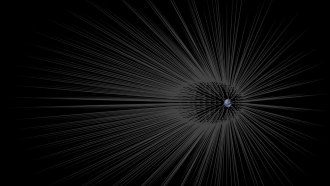
If dark matter particles could kill us, they would have already
Dark matter is a mysterious substance. The fact that no one has been killed by it suggests it is relatively small and light.
- Chemistry
Tiny new magnets are not only squishy but also liquid
Researchers have just created liquid droplets that behave like tiny bar magnets. The movement of these external magnets might help control robots and more.
- Physics
Scientists Say: Big Bang
The Big Bang is the current theory about how our universe came to be. It began with a vast explosion of matter — a very Big Bang.
- Physics
This device turns the kilogram’s new definition into a real mass
A new suitcase-sized device will be able to measure small masses — around 10 grams — with surprising accuracy.