Physics
- Physics
Meteorites may be excavating lunar water
When meteorites hit the moon, water is released from the moon’s soil. That suggests the moon has water buried all across its surface.
- Materials Science
Analyze This: Do exotic woods make better guitars?
When comparing the sound of guitars made from rare and costly woods to those made with common, cheaper alternatives, guitarists couldn’t tell much of a difference.
- Physics
Heat signatures help track down old and still deadly land mines
A new technique for locating land mines uses infrared cameras on drones. The novel technology uses temperature differences to find camouflaged mines before anyone might accidentally step on them.
- Physics
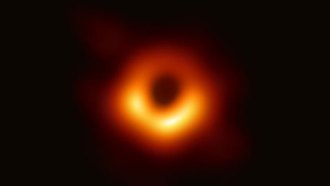
Here’s the first picture of a black hole
The Event Horizon Telescope imaged the supermassive beast lying some 55 million light-years away in a galaxy called M87.
- Physics
It took a ‘virtual’ telescope to actually picture a black hole
Here’s how scientists connected eight observatories across the world to create one Earth-sized telescope. This is what it took to create an image of a black hole.
- Physics
A short history of black holes
From dreaming up black holes to snapping the first picture of one, the history of black holes has had many twists and turns.
- Animals
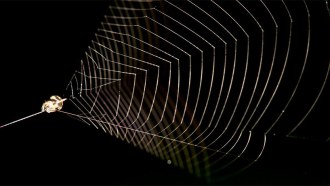
This spider slingshots itself at extreme speeds to catch prey
By winding up its web like a slingshot, this spider achieves an acceleration rate far faster than a cheetah’s.
- Chemistry
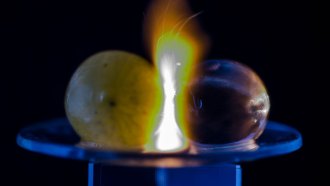
Scientists now know why microwaved grapes make plasma fireballs
Grapes trap microwave energy that bounces back and forth within the fruit. Until boom — a plasma!
- Chemistry
Shape-shifting chemical is key to new solar battery
Storing solar energy is a challenge. A new, shape-shifting molecule may provide a solution.
- Physics
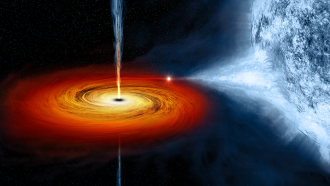
Explainer: What are black holes?
Among the most extreme celestial bodies in the universe, black holes are dense, massive entities whose gravity can sometimes hold together an entire galaxy.
- Climate
Thunderstorms hold stunningly high voltage
By studying particles called muons, scientists found that the electric potential inside a thunderstorm may be 10 times higher than previously thought.
- Health & Medicine
Here’s why Rapunzel’s hair makes a great rope ladder
The fairy tale ‘Rapunzel’ features a princess with a lifesaving head of hair. Could someone really use their hair as a ladder? Sort of.