Physics
- Physics
Scientists Say: Tauonium
No protons, neutrons or electrons. And yet, based on what scientists know about fundamental particles, this variety of atom just might exist.
- Physics
Here’s why your blood vessels don’t burst under pressure
Cells lining the blood vessels reorganize their inner structures to handle stressful boosts in pressure.
- Physics
Here’s how rainwater might one day power some of your lights
In tests, the electricity that water droplets made was small, but kept a dozen LEDs lit. This tech might one day power clean energy for wet or rainy places.
- Planets
Perseverance took the first picture of a visible aurora on Mars
A faint yet visible aurora has been spotted on Mars. It’s the first such light show seen from another planet's surface.
- Physics
Can you Manu? It’s the science-backed way to max your splash
Forget belly flops and cannonballs. Manu jumps — pioneered by New Zealand’s Māori and Pasifika communities — make the biggest blasts.
- Physics
Can a supervillain destroy the sun?
Although our sun is a dwarf yellow star, it’s more than massive enough to weather any attempts to alter it — super or otherwise.
- Materials Science
This electric ‘slime’ might help injuries heal faster
Our bodies call in healing cells with an electrical signal. When stretched or squeezed, this gel makes electricity that could boost that alert.
- Chemistry
Micro-sparks between water droplets may have started life on Earth
This micro-lightning can drive chemical reactions that produce compounds needed for the natural formation of life on Earth, experiments show.
- Physics
Scientists Say: Lepton
Leptons are a quirky class of particles. Besides electrons, they include ghostly neutrinos and hefty muons and tauons.
- Physics
Much of the sun’s light is green. Why does it look yellow?
Sunlight's peak intensity is at a green wavelength. Here’s why it doesn’t appear that way to us.
- Materials Science
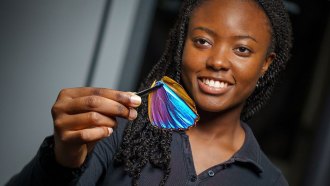
A beautiful blue butterfly wing offers a new way to study cancer
Once a morpho butterfly wing is placed atop a thin slice of tissue, shining polarized light through it can help reveal how likely breast cancer is to spread.
- Materials Science
This engineer uses light to get hearts pumping
Pengju Li designed a new type of pacemaker to help doctors during open-heart surgery.