Perseverance took the first picture of a visible aurora on Mars
Future astronauts will be able to observe the greenish sky glows with their own eyes
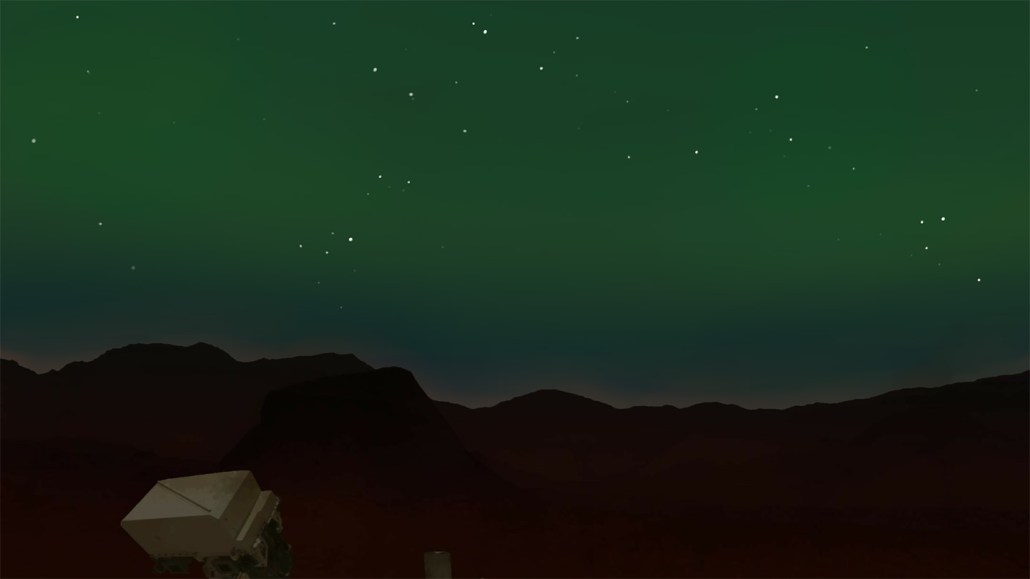
Martian auroras may appear to future astronauts as a faint, green glow that hangs low in the night sky. This illustration shows what such an extraterrestrial light show might look like.
Alex McDougall-Page
On some Martian nights, a subtle, green glow hangs low in the sky. It glimmers just above the horizon in every direction. Now, for the first time, a Mars rover has observed one of these auroras.
NASA’s Perseverance rover witnessed the light show on March 18, 2024. It was the first aurora seen from the surface of a planet other than Earth. And it hints that future astronauts may observe ethereal Martian auroras with their own eyes.
“It would be a dull or dim green glow to astronauts’ eyes,” says Roger Wiens. This planetary scientist works at Purdue University in Lafayette, Ind. He was part of the team that shared the new findings in the May 16 issue of Science Advances.
Auroras can appear when charged particles from space interact with a planet’s atmosphere. They’ve already been spotted on Mercury, Jupiter and every other planet in our solar system. But such non-Earth auroras have only ever been seen by spacecraft orbiting from above. And in Mars’ sky, scientists had only detected auroras with wavelengths of light that are not visible to the human eye.
That left it unclear how Martian auroras would appear to future astronauts.

The new image from Mars is fuzzy, compared to many Earthly aurora photos. There are a couple reasons for this. First, the rover’s cameras perform less well at night, Wiens notes. “The instruments aren’t tremendously more sensitive than human eyes.”
Second, Mars doesn’t have a global magnetic field that concentrates auroras near its poles, as Earth’s does. Instead, Mars’ crust is magnetized in patches. That means auroras can appear all over the planet. They’re just fairly dim.
The particles that prompted this aurora likely arrived with the shock front of a CME. That’s short for coronal mass ejection. CMEs are large clouds of plasma and magnetic fields blasted into space from the sun. Sometimes, they careen toward planets. When they do, CMEs can paint auroras in Earth’s skies too.
Wien’s team got word that a CME was headed for Mars days before it arrived. That allowed them to alert Perseverance to scout for auroras.
Right now, the rover is near Mars’ equator. While there, it could be interesting to look for auroras from Mars’ southern hemisphere, Wiens says. That’s the most magnetized part of the planet. An aurora there, he says, “might look particularly strong.”