atom: The basic unit of a chemical element. Atoms are made up of a dense nucleus that contains positively charged protons and uncharged neutrons. The nucleus is orbited by a cloud of negatively charged electrons.
electron: A negatively charged particle, usually found orbiting the outer regions of an atom; also, the carrier of electricity within solids.
force: Some outside influence that can change the motion of an object, hold objects close to one another, or produce motion or stress in a stationary object.
hydrogen: The lightest element in the universe. As a gas, it is colorless, odorless and highly flammable. It’s an integral part of many fuels, fats and chemicals that make up living tissues. It’s made of a single proton (which serves as its nucleus) orbited by a single electron.
neutron: A subatomic particle carrying no electric charge that is one of the basic pieces of matter. Neutrons belong to the family of particles known as hadrons.
particle: A minute amount of something.
positron: A subatomic particle with the mass of an electron, but a positive electrical charge. It is the antimatter counterpart to the electron. So when electrons and positrons collide, they annihilate each other, releasing energy.
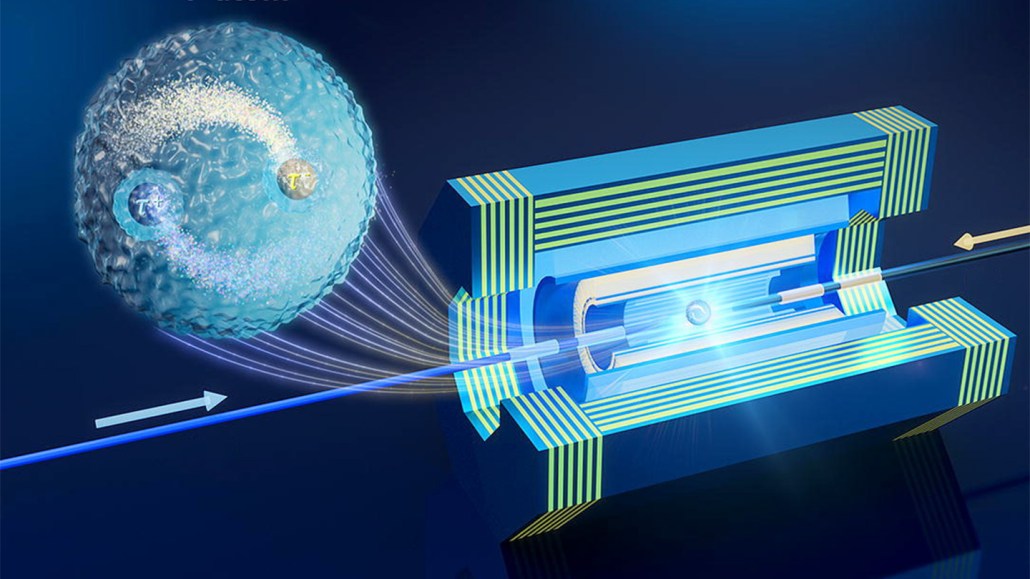
positronium: A short-lived atom made up solely of an electron (a particle with a negative electric charge) and a positron (its antiparticle, which has a positive electric charge). Attracted by their opposite charges, the electron-positron pair orbit each other much as do binary stars.
proton: A subatomic particle that is one of the basic building blocks of the atoms that make up matter. Protons belong to the family of particles known as hadrons.
strong force: (in physics) A fundamental interaction in nature, one that binds quarks together to make other types of subatomic particles, such as protons and neutrons. This force also holds protons and neutrons together within an atom’s nucleus. Not all subatomic particles can “feel” this force. Electrons and other leptons, for instance, are immune to it.