Space
- Planets
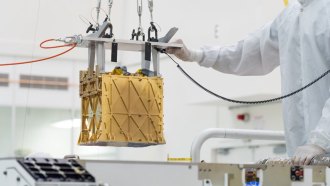
The Perseverance rover split CO2 on Mars to make breathable air
This oxygen-making experiment shows that astronauts could one day make air to breathe and to help fuel their ride back home.
- Physics
Raindrops on alien worlds will obey Earth-like rules
Their size will be similar no matter what they’re made of or on which planet they fall, a new analysis finds.
- Physics
Staying grounded in space requires artificial gravity
On TV, people in space walk around like they’re on Earth. How can science give real astronauts artificial gravity? Spin right round, baby.
- Physics
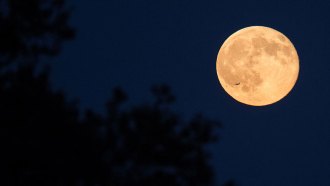
Scientists discover likely source of the moon’s faint yellow tail
These sodium atoms are part of the debris kicked up from the moon’s surface, mostly by micrometeorites, two new studies conclude.
- Science & Society
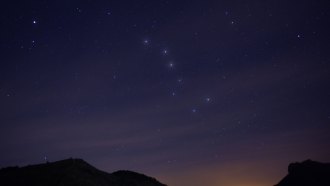
Here’s why people picked certain stars as constellations
Patterns of human eye movement help explain why particular sets of stars form iconic shapes, a high school student showed.
- Space
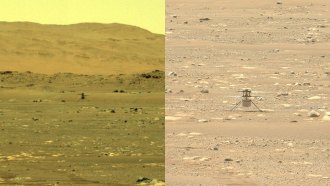
Ingenuity helicopter makes history by flying on Mars
The copter's 40-second-long flight in the Red Planet’s thin air is only the first in a planned series of daring flights.
- Planets
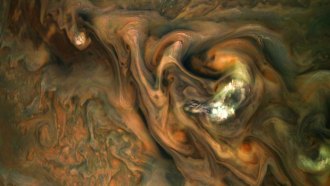
Signs of a hidden Planet Nine in our solar system may be an illusion
Hints of the remote planet, also called Planet X, relied on clumped up orbits of bodies beyond Neptune. A new study suggests that clumping doesn’t exist.
- Planets
Let’s learn about the moon
The moon is Earth’s nearest neighbor, and its gravity helps stabilize the planet’s climate and creates the tides.
- Planets
Scientists Say: Planet
Planets have to orbit a star, be big enough to form a sphere and keep other objects out of their path around their star.
- Space
Exploding neutron star proves to be energy standout of the cosmos
This is what scientists had suspected. But until one showed up outside our galaxy, they couldn’t be sure. Now they are.
- Health & Medicine
Space travel may harm health by damaging cells’ powerhouses
Biochemical changes after going to space suggest that harm to cells’ energy-producing structures, called mitochondria, could explain astronauts’ health issues.
- Physics
Let’s learn about gravity
Gravity is an attraction between objects with mass. The more massive the object, the more gravity it’s got.