Monkeys might share our instincts for math
When matching shapes in a game, monkeys appear to approach it much as human kids do
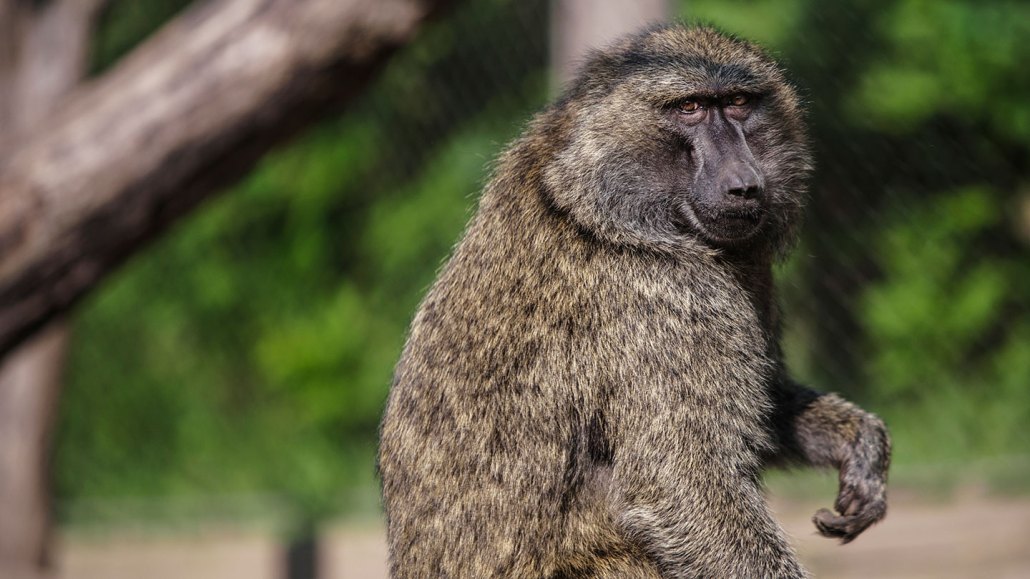
To show how monkeys and humans think about shapes, scientists had them play games — and even had kids design some games that the primates played.
Scott Hamilton/RIT
There are some skills that people think set us apart from other animals. These usually include language, tool use or the ability to do some types of math. But at least some cows can use tools and cockatoos can make their own. Other animals appear to have language. And now, it seems, we’re not even the only ones with a head for math.
A new study compared preschool kids, monkeys and groups of adults who hadn’t studied geometry (the math of shapes). All appeared to understand shapes in similar ways.
Researchers shared what they learned July 20. The work appeared in Proceedings of the National Academy of Sciences.
People spend a lot of time asking what it is that makes us different from other, similar animals, such as monkeys. “We look around, we notice how weird we are in the world and we want to know how something like this happens,” says Jessica Cantlon. A cognitive neuroscientist at Carnegie Mellon University in Pittsburgh, Pa., she studies how humans and animals think.
One thing scientists thought might make us different from other primates is how we think about geometry, notes Jialin Li. She, too, is a cognitive neuroscientist at Carnegie Mellon. Tens of thousands of years ago, she notes, people were drawing “right angles, parallel lines, equal size, equal lines.” These are basic ideas behind geometry.
That led some to suspect that the human mind must process shapes in a different way than a monkey’s — a way that has nothing to do with whether we’ve been to a geometry class.
Monkeying around with shapes
To test this, Cantlon and Li needed some shapes, clever games and a bunch of people. Oh, and monkeys, too. Don’t forget the monkeys.
The scientists studied how well different groups matched shapes in a game. They compared two groups of people: Tsimane’ people from Bolivia and Himba people from Namibia. Neither group goes to schools where they would study shapes, as most U.S. students do. The scientists also compared U.S. preschoolers and two groups of monkeys — rhesus monkeys in a lab and olive baboons in a zoo.
All had to complete tests on a screen, matching shapes and angles. The monkeys worked for treats, Li notes, and some really enjoyed the games. Preschoolers worked for stickers and were a little harder to convince. “Sometimes kids reject you,” she says. “You have to bargain with them.”
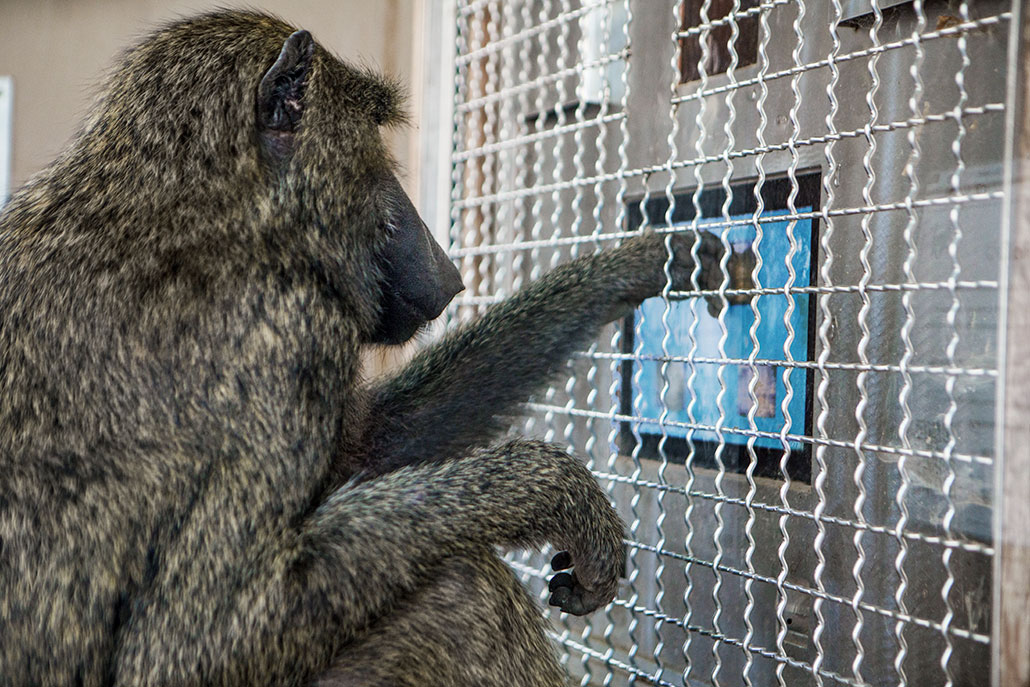
For some tests with monkeys, Cantlon and Li’s team worked with Caroline DeLong. She studies animal minds at the Rochester Institute of Technology in New York. Together, the researchers developed a Primate Portal. It let a group of olive baboons at the Seneca Park Zoo in Rochester play math games.
The portal is a cabin inside the olive baboon enclosure. Outside the hut, a screen displays games for the monkeys to play. Inside the hut sits a scientist putting games on the screen and giving out treats. One big male monkey, Kalamata, is an avid gamer. “He will play for hours a day,” DeLong says. The problem is trying to give other monkeys a chance!
How everyone shaped up
The researchers looked at how well each group did — and what mistakes they made. Then, they compared those mistakes to two computer models. The models were meant to mimic different ways of thinking about shapes.
Both monkey species and all of the humans made similar types of mistakes. This hinted that their minds were thinking about shapes in similar ways.
“Humans are not unique in this,” Li concludes, “but we are better.”
It’s exciting to see scientists looking at how geometric thinking came to be, says Moira Dillon, who did not take part in the study. She works at New York University in New York City, where she studies how minds develop. A model can offer one way to explain something, she says. But computer models aren’t minds. And, she notes, scientists can’t get into minds to follow how a monkey or kid thinks while playing a math game. So, she says, “I think there still remains the question of whether the mind is doing it that way.”
The new work used only two computer models, points out Véronique Izard. “Could they model it even better?” she wonders. Perhaps monkeys and humans seem very similar now, but a different model might find differences that these two missed. Izard works at the University of Paris Cité and the National Centre for Scientific Research in France. There, she studies how minds develop.
A primate portal
Preschoolers weren’t the only kids involved in this research. Elementary school students are now programming games for the baboons.
To test shape knowledge, for instance, monkeys played a game called match-to-sample. A shape pops up, like a square. Then two shapes pop up, a square and a triangle. The monkey needs to pick which shape matches the first. If the monkey gets it right, it receives a piece of fruit cereal.
“It’s like a weird Froot Loop, and it does not taste good,” says Michael Sufra. Michael, 11, is a student at QUEST Elementary School in Hilton, N.Y. He coded his own match-to-sample games for monkeys. “It’s just really fun to make your own games,” he says.
He was part of a program where every kid got to code their own match-to-sample game. Michael used rocket shapes and a cartoon cat. Not only do students have to think about code, but also about the pictures, explains Cora Dimino, 12. If images are too much alike, “monkeys can’t really do that,” she says. (Her game had monkeys match animal images in different colors.)
Cora and Michael are two out of several hundred kids who have been able to make monkey games. They also watched monkeys play them. “There’s real joy in their faces when they see that,” DeLong says. And she’s shown that coding games for monkeys helps kids get better at problem-solving. DeLong hopes to even use some of the kids’ games in her monkey research.
Both Cora and Michael enjoy coding and were interested to learn that games like theirs showed that monkeys think about math much as we do. “I feel like monkeys are pretty smart, based off of what we saw,” Cora says. “It’s justice for the monkeys.”
Do you have a science question? We can help!
Submit your question here, and we might answer it an upcoming issue of Science News Explores