antifungal Having properties that prevent or limit the growth of fungi.
average (in science) A term for the arithmetic mean, which is the sum of a group of numbers that is then divided by the size of the group.
bat A type of winged mammal comprising more than 1,100 separate species — or one in every four known species of mammal.
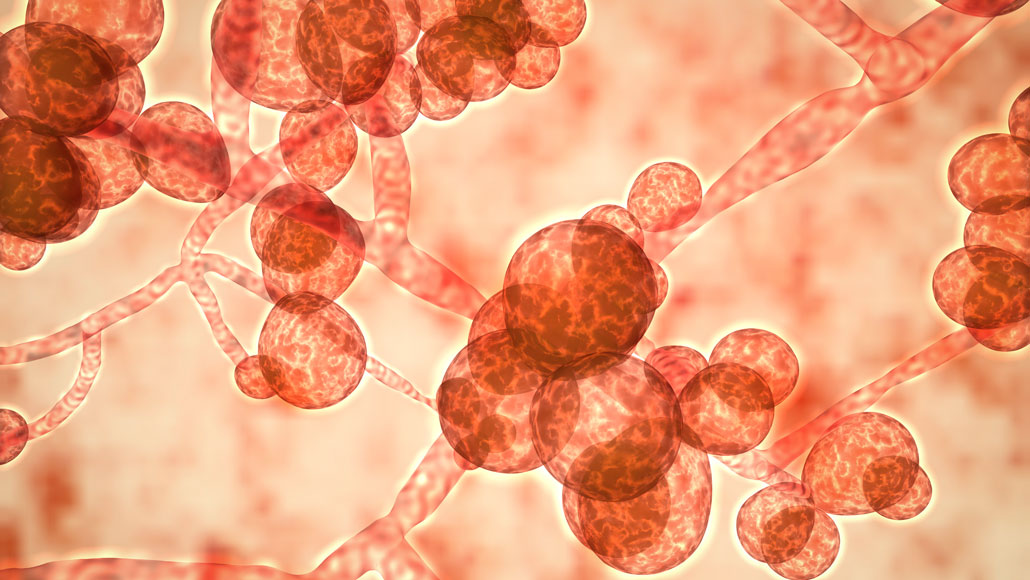
Candida A genus of yeasts that are ubiquitous across the globe. More than 20 species have been linked to disease in people and animals.
cell The smallest structural and functional unit of an organism. Typically too small to see with the unaided eye, it consists of a watery fluid surrounded by a membrane or wall. Depending on their size, animals are made of anywhere from thousands to trillions of cells. Most organisms, such as yeasts, molds, bacteria and some algae, are composed of only one cell.
climate The weather conditions that typically exist in one area, in general, or over a long period.
climate change Long-term, significant change in the climate of Earth. It can happen naturally or in response to human activities, including the burning of fossil fuels and clearing of forests.
colleague Someone who works with another; a co-worker or team member.
continent (in geology) The huge land masses that sit upon tectonic plates. In modern times, there are six established geologic continents: North America, South America, Eurasia, Africa, Australia and Antarctica. In 2017, scientists also made the case for yet another: Zealandia.
defense (in biology) A natural protective action taken or chemical response that occurs when a species confront predators or agents that might harm it. (adj. defensive)
environment The sum of all of the things that exist around some organism or the process and the condition those things create. Environment may refer to the weather and ecosystem in which some animal lives, or, perhaps, the temperature and humidity (or even the placement of things in the vicinity of an item of interest).
evolve (adj. evolving) To change gradually over generations, or a long period of time. In living organisms, such an evolution usually involves random changes to genes that will then be passed along to an individual’s offspring. These can lead to new traits, such as altered coloration, new susceptibility to disease or protection from it, or different shaped features (such as legs, antennae, toes or internal organs). Nonliving things may also be described as evolving if they change over time. For instance, the miniaturization of computers is sometimes described as these devices evolving to smaller, more complex devices.
fungus (plural: fungi) One of a group of single- or multiple-celled organisms that reproduce via spores and feed on living or decaying organic matter. Examples include mold, yeasts and mushrooms.
genetic Having to do with chromosomes, DNA and the genes contained within DNA. The field of science dealing with these biological instructions is known as genetics. People who work in this field are geneticists.
hibernation A state of inactivity that some animals enter to save energy at certain times of year. Bears and bats, for example, may hibernate through the winter. During this time, the animal does not move very much, and the use of energy by its body slows down. This eliminates the need to feed for months at a time.
immune (adj.) Having to do with the immunity. (v.) Able to ward off a particular infection. Alternatively, this term can be used to mean an organism shows no impacts from exposure to a particular poison or process. More generally, the term may signal that something cannot be hurt by a particular drug, disease or chemical.
immune system The collection of cells and their responses that help the body fight off infections and deal with foreign substances that may provoke allergies.
infection A disease that can spread from one organism to another. It’s usually caused by some type of germ.
invasive An adjective that refers to something that can invade some environment (such as an invasive species) or alter some environment (such as invasive medical procedures).
mammal A warm-blooded animal distinguished by the possession of hair or fur, the secretion of milk by females for feeding their young, and (typically) the bearing of live young.
microbiology The study of microorganisms, principally bacteria, fungi and viruses. Scientists who study microbes and the infections they can cause or ways that they can interact with their environment are known as microbiologists.
online (n.) On the internet. (adj.) A term for what can be found or accessed on the internet.
outbreak The sudden emergence of disease in a population of people or animals. The term may also be applied to the sudden emergence of devastating natural phenomena, such as earthquakes or tornadoes.
replicate (in biology) To copy something. When viruses make new copies of themselves — essentially reproducing — this process is called replication. (in experimentation) To copy an earlier test or experiment — often an earlier test performed by someone else — and get the same general result. Replication depends upon repeating every step of a test, one by one. If a repeated experiment generates the same result as in earlier trials, scientists view this as verifying that the initial result is reliable. If results differ, the initial findings may fall into doubt. Generally, a scientific finding is not fully accepted as being real or true without replication.
risk The chance or mathematical likelihood that some bad thing might happen. For instance, exposure to radiation poses a risk of cancer. Or the hazard — or peril — itself. (For instance: Among cancer risks that the people faced were radiation and drinking water tainted with arsenic.)
species A group of similar organisms capable of producing offspring that can survive and reproduce.
syndrome Two or more symptoms that together characterize a particular disease, disorder or social condition.
thermal Of or relating to heat. (in meteorology) A relatively small-scale, rising air current produced when Earth’s surface is heated. Thermals are a common source of low level turbulence for aircraft.
white nose syndrome A fungal disease affecting bats. The fungus, Pseudogymnoascus destructans, lives in caves where bats hibernate through the winter. It causes a white dusting on their noses and on other areas of the body. The fungus causes dehydration and can eat holes through bats’ wings and blood vessels. Eventually, it weakens them, leaving them unable to fly and find food.