This game designer shares neurodivergent experiences through gaming
Susannah Emery designs games that raise awareness about social issues
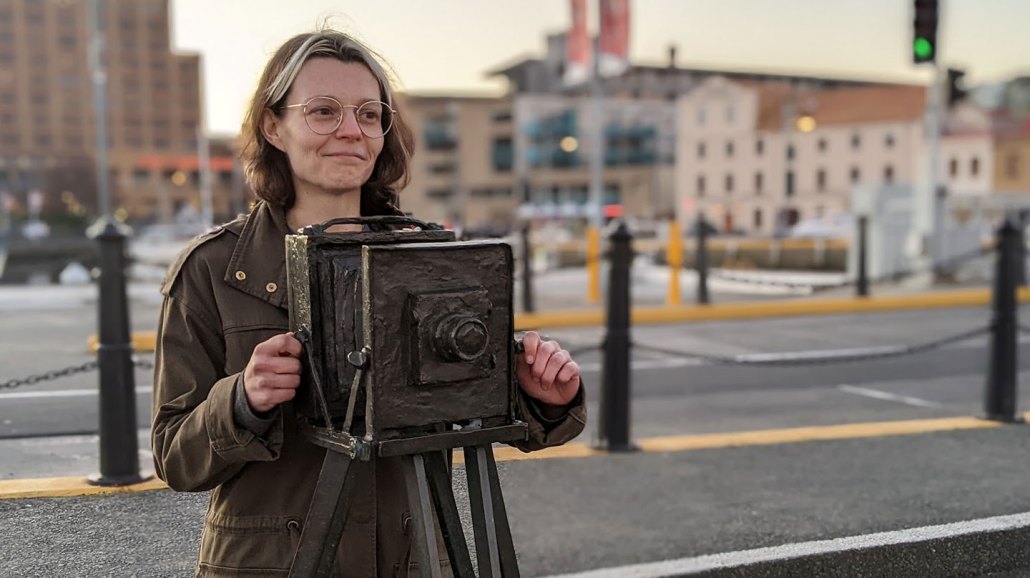
Susannah Emery designs games focused on social issues. As a Women in Games Ambassador, she also mentors aspiring game designers and gives talks at events. Emery aims to help more women and nonbinary people share their stories through games. “We want your stories and your voices. We want to help you create those things,” she says.
S. Emery
Share this:
- Share via email (Opens in new window) Email
- Share on Facebook (Opens in new window) Facebook
- Share on X (Opens in new window) X
- Share on Pinterest (Opens in new window) Pinterest
- Share on Reddit (Opens in new window) Reddit
- Share to Google Classroom (Opens in new window) Google Classroom
- Print (Opens in new window) Print
This is a human-written story voiced by AI. Got feedback? Take our survey . (See our AI policy here .)
In Susannah Emery’s video game Life (Re)Sounding, players won’t be fighting off alien invasions or monsters. Instead, gamers must navigate everyday tasks from the perspective of someone who is neurodivergent. Neurodivergent people often learn or sense the world differently than others.
Life (Re)Sounding draws from her own experiences as a neurodivergent person. With the game, Emery hopes to show how we can better understand and accommodate the needs of neurodivergent individuals. “It’s designed to show that it’s the world itself that causes the challenges that we face, rather than ourselves,” she says.
In one level, players are tasked with cleaning up trash scattered around a room. Every time the player tosses trash into a bin, the lights brighten — until it becomes too bright to see. “I experience a lot of light sensitivity,” says Emery. “It [becomes] this horrible white, bright mess, which can happen to me if I’m somewhere for too long.”
At Adelaide University in Australia, Emery designs games that raise awareness about social issues. These offer ways to interact with everyday experiences that are often misunderstood, she says. “Games as a medium are a really powerful way to do that.” In this interview, she shares her experiences and advice with Science News Explores. (This interview has been edited for content and readability.)
What inspired you to start your career?
During my final year of high school, I saw that you could study multimedia at university. This included courses on interactive media, film, TV and video games. It sounded great. But one of the career people at my school said that it might not be a great career for a girl. They recommended I consider something else.
At first, I believed them. Then I attended an open day at one of the universities I was considering. I sat in on a presentation about the multimedia program. The presenter was not only the head of the department but also a woman. As soon as I saw her, I realized I could study multimedia, too. That’s what I ended up studying for my first undergrad degree.
How did you get to where you are today?
After earning my undergrad degree in multimedia, I moved to a remote community belonging to the Anangu people in the Northern Territory to teach. Many of the kids I was teaching didn’t want to come to school. They weren’t engaging with the lessons but really loved video games. I thought about how to combine the two.
The Nintendo Wii console and Wii Sports game came to mind. I drove two and a half hours to buy them from a secondhand store. That Monday, I fired up the game and covered up the scoring with a piece of paper. Instead of relying on the game’s scoreboard, I had the students keep score on the whiteboard. After that, our attendance rate skyrocketed.
I was inspired by seeing how video games could make kids invested in their learning. I ended up doing an honors degree looking into the connection between education and games. I co-designed a game with the community that combined First Nations knowledge and the Australian curriculum. I loved it so much that I enrolled in a Ph.D. program. That degree involved looking at how games can raise awareness of domestic violence.
What challenges do women and nonbinary people face in the gaming industry?
When you look at who’s playing games in Australia, it’s evenly split between male and female. And then, of course, there are nonbinary people as well. But when you look at who’s making games, that same split isn’t reflected. In Australia, for example, a recent report showed that only 22 percent of game developers identify as female. That’s a problem that we need to keep working on in the industry. The makeup of those making games should reflect the people who are playing them. That’s so people see themselves reflected in those games.
How is artificial intelligence (AI) impacting the work that you do?
I think AI is really powerful and can do some really cool stuff. It shines in helping us bring our ideas to life. But to be engaging, games should be about human stories. We all have such cool stories that live inside us. These include our past experiences and future dreams.
We can use AI to help us bring those out in our creative work. But when AI becomes the creator, those games start missing those human stories. Nobody will want to play games made by AI because they’ll just be recreations of other games that already exist. I find that boring and not creative.
AI can code like a boss. But it hasn’t gone through the same things you have. It hasn’t been to school or visited the places you have. It doesn’t have the friends you have.
What would you recommend to those who are interested in the gaming industry?
Get started making your own games. That could be making them on paper in a way similar to Dungeons and Dragons. Or you could use free game engines such as Scratch and Twine. Make games with your friends and play. Playing and practicing is what it’s about.
Making games requires a lot of repetition. You’ll come up with a game idea and then try it out. That lets you find what isn’t quite working. You then make changes and play again. You repeat those steps until you’re satisfied. We call that “play testing.” That’s what we do when we make games.
Sometimes it takes years for us to make games. We go through hundreds or even thousands of tests to get it quite how we want. There’s no failure in games. There’s a restart, right? When Mario falls down the hole, you go back a bit and try again.