All Stories
- Chemistry
Teen finds cheaper way to make drugs against killer viruses
This drug-making achievement also nabbed the top award — and $100,000 in prize money — at the 2025 Regeneron ISEF competition.
- Space
Is the International Space Station too clean?
Testing surfaces on board the space station revealed low microbial diversity, something that’s been linked to health problems elsewhere.
- Artificial Intelligence
Teen’s software for spotting AI-generated text just got personal
Rather than seeking generic signs of AI-generated text, it compares two texts to confirm they both share a writer’s unique style.
- Artificial Intelligence
AI, make me a video game
Developers can use AI to generate code, dialog, playable environments and more. But at its heart, making video games remains a creative human endeavor.
- Chemistry
Micro-sparks between water droplets may have started life on Earth
This micro-lightning can drive chemical reactions that produce compounds needed for the natural formation of life on Earth, experiments show.
- Planets
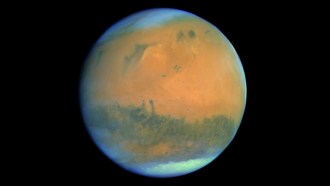
Mars’ rust suggests it was once wet — and its seas frigid
Mars may once have held enough water to fill oceans and form coastlines. And the planet’s red dust hints that its seas would have been quite frigid.
- Plants
Let’s learn about plant movement
Some plants use their powers of superspeed to spread spores, while others use it to snatch up prey.
- Animals
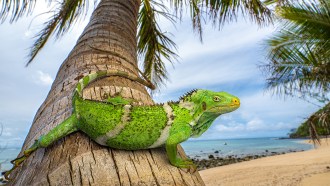
Some iguanas may have rafted across the Pacific 30 million years ago
The iguanas' epic 8,000-kilometer trip — one-fifth of Earth’s circumference — may be the longest made by a flightless land vertebrate.
- Physics
Scientists Say: Lepton
Leptons are a quirky class of particles. Besides electrons, they include ghostly neutrinos and hefty muons and tauons.
- Math
Meet one of the ‘world’s most interesting’ mathematicians
Angela Tabiri uses her enthusiasm for math to inspire young people — and to highlight African female mathematicians on a YouTube channel.
- Fossils
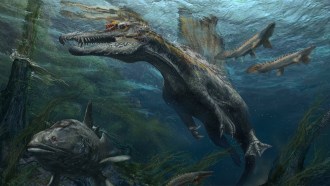
Could Spinosaurus swim? That would make it a game changer
Spinosaurus fossils are challenging the longstanding claim that ancient dinosaurs were never fully aquatic. And some paleontologists still aren’t convinced.
- Health & Medicine
ADHD symptoms may boost teens’ risk of vaping or smoking
Having multiple ADHD symptoms increases a teen’s risk of using vapes or other tobacco. That’s bad because nicotine is especially addictive for kids.