Scientists Say
A weekly word defined, in a sentence and in context. Click here to find the alphabetized list.
- Math
Scientists Say: Pi
Pi is the ratio of a circle’s circumference to its diameter. But some mathematicians say life would be easier if we used a different ratio instead.
- Animals
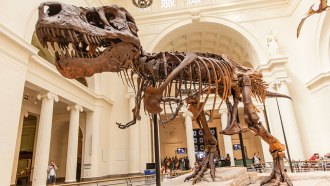
Scientists Say: Dinosaur
Dinosaurs emerged between 243 and 233 million years ago. While some died out 66 million years ago, others are still with us — birds.
- Health & Medicine
Scientists Say: Placebo
In clinical trials, scientists often test a drug or procedure against a placebo — a treatment that has no effect — to find out how well their new treatment works.
- Physics
Scientists Say: Acceleration
Acceleration is a change in velocity. That could mean a change in speed or in direction.
- Physics
Scientists Say: Radiation
Radiation is the motion of energy through space as waves or particles.
- Brain
Scientists Say: Neuron
Neurons are the foundational cells in the nervous system. They pass along and process information using electrical signals.
- Fossils
Scientists Say: Hominid
Scientists are still working out what counts as a hominid. Some say it’s just people and our extinct ancestors. Others say add more apes.
- Animals
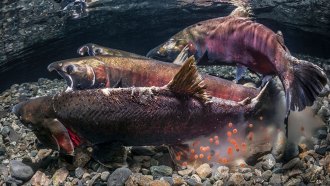
Scientists Say: Egg and sperm
An egg or a sperm cell contains half of the normal genes an organism needs. They fuse together to form a new individual.
- Climate
Scientists Say: Weather
The state of the atmosphere in a specific place and time is weather. Over a long time, the weather conditions in an area will reveal its climate.
- Planets
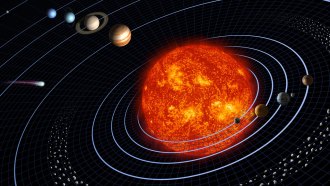
Scientists Say: Planet
Planets have to orbit a star, be big enough to form a sphere and keep other objects out of their path around their star.
- Math
Scientists Say: Outlier
Data points often fall within a normal range. When one data point sticks out a lot, it might be an outlier.
- Animals
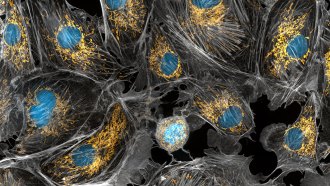
Scientists Say: Organelle
An organelle is a part of a cell with a particular function. Like organs. But for cells.