Physicists may have finally glimpsed elusive dark matter
This invisible substance fills the cosmos but has never been directly observed

The LZ dark-matter detector is shown here, while still under construction. This machine has now spotted a single event that could be a dark-matter particle. To be certain, scientists will need more data.
Matthew Kapust/Sanford Underground Research Laboratory
One day in June 2023, the many unblinking, electronic eyes of the LUX-ZEPLIN detector — LZ for short — may have glimpsed something remarkable. They may have made the first direct detection of dark matter.
Or it may have been just another Friday.
Dark matter is the invisible stuff thought to make up most of the matter in the cosmos. Scientists can sense its gravity tugging on stars and other objects in space. But no one knows what it is. No one has ever directly observed it either, despite decades of searching.
Now, an LZ experiment might have found a single particle interaction that fits the bill. The LZ team shared its findings September 1 at the TeV Particle Astrophysics meeting in Tendo, Japan.
One event is not conclusive. Without more data, scientists can’t be sure that dark matter caused the signal they spotted.
Still, the unexpected particle event has physicists buzzing.
“It’s the most interesting thing that’s come up in recent times,” says Wick Haxton, who did not take part in the research. A theoretical physicist, he works at the University of California, Berkeley. “I definitely think that there’ll be a flood of people looking at this event,” he says.
Watching for WIMPs
LZ is housed at the Sanford Underground Research Facility in Lead, S.D. There, it searches for weakly interacting massive particles, or WIMPs. Scientists have proposed that such particles might make up dark matter.
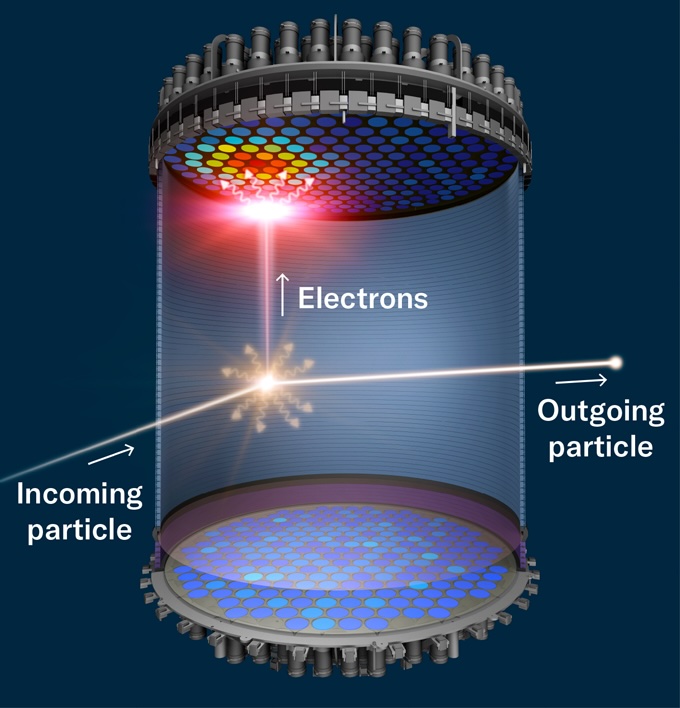
If they exist, WIMPs might crash into the nuclei of atoms in LZ’s tank of liquid xenon. Such a collision would send a xenon nucleus zinging away. In the process, it would give off a small flash of light and electrons. LZ’s sensors could spot such debris.
Dual signals
The LZ detector is designed to spot two signals when a dark-matter particle inside it interacts with an atomic nucleus. As the nucleus recoils, it creates a flash of light. That glint is detected immediately by arrays of light sensors (circles at top and bottom). The event also releases electrons (red). These particles drift through the detector due to an electric field. When the electrons reach the top, they make another flash of light.
The new study looked for a proposed version of WIMPs that fling xenon nuclei away at high energies. The team combed through 220 days’ worth of data.
In the end, “we got left with one event, which is fascinating. Absolutely fascinating,” says Rick Gaitskell. This physicist works at Brown University in Providence, R.I. He’s also a spokesperson for LZ.
There’s only about a 1 in 100 chance that known, non-WIMP particles could cause such an event, the LZ team estimates. Physicists convey such odds in terms of a figure called sigma. In this case, their certainty that a WIMP caused the event is 2.6 sigma. Physicists usually need a sigma of 3 to claim they have evidence for something. They need 5 sigma to say they’ve detected it for sure.
Not so wimpy WIMPs
A past study had combed through the same data looking for xenon nuclei zooming away from WIMP smashups at low energies. That’s typically what scientists would expect from WIMP interactions. And that search came up empty.
This hints that dark matter might interact in a way that makes atomic nuclei recoil with a lot of oomph.
WIMPs could have different energy states, much as atoms do. Such a WIMP might interact only if there’s enough energy to bump it up to its next energy level. This would put a lower limit on the energy of the atomic nucleus it kicks away.
For that type of interaction, dark-matter events are expected to occur more in the summer. That’s when Earth is plowing through the dark matter in our galaxy more head-on. This creates more higher-energy collisions.
It also makes the June 2023 event particularly notable, says Neal Weiner. Though not part of the LZ team, he’s a theoretical physicist at New York University in New York City.

What comes next
Dark-matter experiments have a history of getting scientists’ hopes up — and then dashing them.
In 2020, for instance, the XENON1T experiment in Italy saw a hint of new particles that seemed like they could be dark matter. A later version of that experiment showed this was not the case.
Even if the newfound event was not caused by dark matter, the study proves the value of LZ and similar detectors. “We have these incredible machines,” Weiner says. It’s been unclear if they could be used to search for particles that don’t match the original predictions for WIMPs. “One really exciting top-line result is, yes, they can.”
Meanwhile, LZ has collected more data. In fact, it’s gathered at least three times as much data as researchers have analyzed. If dark matter really is behind the 2023 event, there are likely others waiting to be found.
“People have looked for [dark matter] for such a long time, and with growing frustration that it hasn’t been found,” Haxton says. “It would be very nice if this event is followed by a few more.”
Do you have a science question? We can help!
Submit your question here, and we might answer it an upcoming issue of Science News Explores