Uncategorized
- Chemistry
Batteries should not burst into flames
Because lithium-ion batteries power modern life, they need to store a lot of energy. Now scientists are focusing on making them safer.
- Health & Medicine
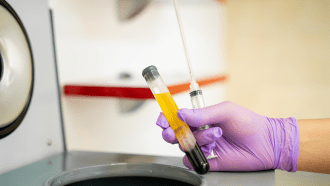
Antibodies from former COVID-19 patients could become a medicine
The experimental treatment uses antibodies from the blood plasma of COVID-19 survivors. It may prevent disease in other people or help treat the sick.
- Chemistry
Let’s learn about the periodic table
This iconic chart holds information about all the known elements. As more are discovered, the table expands.
- Math
Lack of diversity in his field has troubled this mathematician
As a kid, Edray Goins didn’t like math. But he fell in love with the subject in college and is now training the next generation of minority mathematicians.
- Space
Let’s learn about black holes
Scientists released the first-ever picture of a black hole a year ago. But just what are these mysterious objects?
- Physics
Scientists Say: Photon
This word describes light as a particle. A photon is the tiniest possible bit of electromagnetic radiation.
- Fossils
This dinosaur was no bigger than a hummingbird
The skull of one of these ancient birds — the tiniest yet known — was discovered encased in a chunk of amber originally found in Myanmar.
- Health & Medicine
New ultrasound treatment kills off cancer cells
Low-frequency ultrasound destroys cancer cells while leaving most healthy cells intact.
- Psychology
Five tips for learning better from home
When adapting to learning a new way, such as online from home, you may need to adjust habits and more actively reach out when help is needed.
- Science & Society
From buses to low-cost internet: Creative paths to online access
From loaner computers and ‘shared’ or reduced-cost internet, U.S. schools and companies are bringing the internet to social-distancing students.
- Psychology
Learning will change with COVID-19’s social distancing
As COVID-19 has shuttered schools to foster social distancing, the way kids learn is changing. Here are tips from some of the first sidelined classrooms.
- Earth
Let’s learn about geysers and hydrothermal vents
These are places where superhot water streams out of the earth. Plate tectonics explains how they form.