Uncategorized
- Health & Medicine
Too many football hits can change the brain
A former football player who died in his mid-20s had serious Alzheimer's-like damage that doctors are now linking to repeated concussions.
- Space
New recipe for monster black holes
The conventional idea for how black holes form would not easily allow for huge ones to develop in the early universe. Yet they did. Now a scientist offers a new view: galaxy mash-ups!
- Chemistry
Scientists Say: Acid
When a chemical tastes sour, ranks below 7.0 on the pH scale and has many hydrogen ions in its solution, it gets a special name.
- Health & Medicine
Back off the bacon and cold cuts?
Here’s how to make sense of the World Health Organization report that has just linked certain meats to a dangerous cancer.
- Earth
Bubbles may have sheltered Earth’s early life
For Earth’s earliest inhabitants, a bubble on the beach would have been the next best thing to a safety blanket.
- Climate
Arctic ice travels fast, carrying pollution
Climate change is melting old sea ice in the Arctic. Now, younger, thinner ice is migrating far and fast, taking pollutants with it.
- Health & Medicine
Allergies linked to obesity and heart risks
Children and teens with asthma, allergies or other autoimmune conditions tend to be overweight and show symptoms of heart-disease risks, a new study finds.
- Chemistry
News Brief: 2016 brings four new elements
U.S., Russian and Japanese scientists have just been credited with official discoveries of elements 113, 115, 117 and 118. Next up: Naming them.
- Chemistry
Mystery ‘earmuffs’ sit deep inside Earth
Two vast blobs in Earth’s lower mantle could result from a “trainwreck” of ancient colliding tectonic plates.
- Genetics
Scientists Say: Mutation
Information in an organism is stored in a code. Here’s the word scientists use to describe a change in that code.
- Animals
Faking out whales
A false “dinner bell” can safely distract hungry whales from stealing fish from commercial fishing lines, new research shows.
- Earth
News Brief: Why rainbows can lose some hues
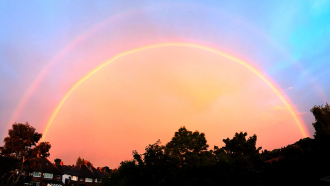
When the sun is right near the horizon, such as at sunset, its light travels through the most atmosphere. When there’s also plenty of water in the air, this can rob colors from a rainbow, scientists now report.