Let’s learn about Tyrannosaurus rex
Many open questions remain about this iconic dinosaur’s appearance, speed, brainpower and more
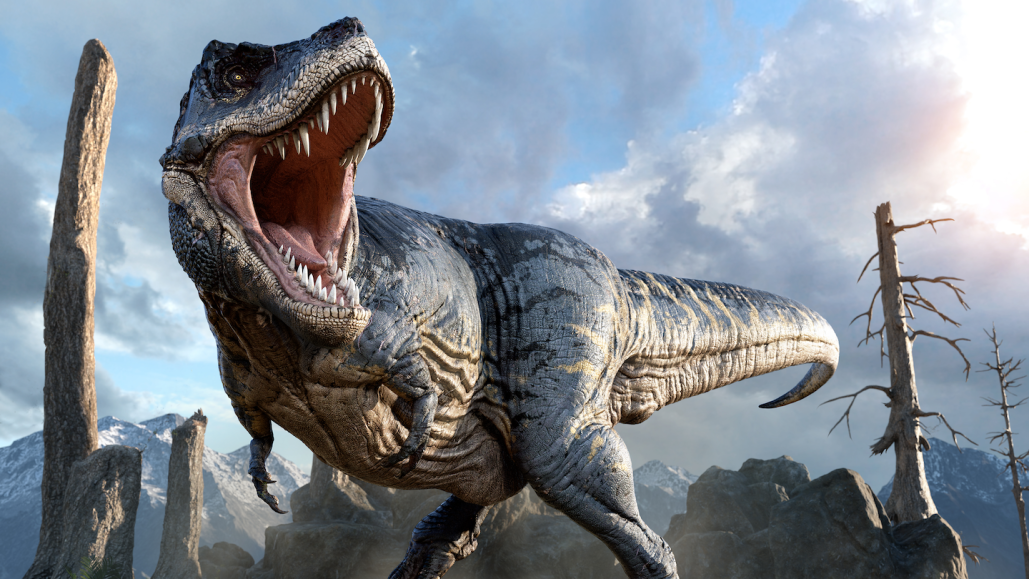
Tyrannosaurus rex truly was a fearsome predator in its time.
Warpaintcobra/iStock/Getty Images Plus
Share this:
- Share via email (Opens in new window) Email
- Share on Facebook (Opens in new window) Facebook
- Share on X (Opens in new window) X
- Share on Pinterest (Opens in new window) Pinterest
- Share on Reddit (Opens in new window) Reddit
- Share to Google Classroom (Opens in new window) Google Classroom
- Print (Opens in new window) Print
This is a human-written story voiced by AI. Got feedback? Take our survey . (See our AI policy here .)
An iconic scene in the classic 1993 film Jurassic Park begins with water glasses shaking on a dashboard. The vibrations sending ripples through the water turn out to be the stomping steps of a huge Tyrannosaurus rex. After escaping its enclosure, the dinosaur lumbers out onto a road. There, it uses its jaws — lined with knife-sized teeth — to tear apart a car, trying to eat the terrified park visitors huddled inside.
This scene gets some things about T. rex right. But other aspects don’t quite match what paleontologists know about this famous dinosaur.
Let’s get the word “Jurassic” out of the way first. Despite the name of the park in the film, T. rex did not live in the Jurassic Period. (That was about 201 million to 145 million years ago.) T. rex lived about 68 million to 66 million years ago. That puts it firmly in the Cretaceous Period (145 million to 66 million years ago).
In its time, T. rex truly was a fearsome predator, stalking prey across what is now western North America. Fossils have shown that T. rex could grow up to 12 meters (40 feet) long and 3.6 meters (12 feet) high. (Some scientists suspect T. rex could have gotten even bigger.) It may have weighed as much as a large elephant.
What’s more, a T. rex’s jaws really were jaw-dropping in size. They could be about 1.2 meters (4 feet) long and filled with roughly 15-centimeter-long (6-inch-long) teeth. Its bite packed a force of more than 6 metric tons, which was enough to crush bones — and maybe even a car.
But Jurassic Park’s depiction of the T. rex maw may not have been quite right. The movie monster’s teeth were on full display, even when its mouth was closed. This is similar to the setup in modern crocodiles’ mouths. But recent evidence suggests that T. rex teeth — like those of modern Komodo dragons — were hidden behind lips.
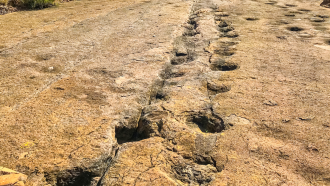
Science also casts doubt on how fast T. rex ran in the movie. In another famous Jurassic Park scene, a sprinting T. rex keeps up with a speeding car. But calculations based on fossilized footprints show that T. rex could only run about 20 to 40 kilometers (12 to 25 miles) per hour. Recent experiments with birds — the only dinos alive today — suggest that those estimates may be off.
There are still many other open questions about possibly the most famous dinosaur of all. Yet scientists — including curious teens — continue to uncover new insights into the terrifying T. rex.
Want to know more? We’ve got some stories to get you started:
Analyze This: How big was the biggest T. rex? Only around 80 fossil Tyrannosaurus rex skeletons have been found. They probably don’t include the biggest T. rex that ever lived. (11/20/2024) Readability: 6.2
Just how brainy was a T. rex? A debate rages over how to count brain cells in dinosaurs. At issue: figuring out how these extinct animals likely behaved. (7/25/2024) Readability: 7.9
The secret to T. rex‘s incredible biting force is at last revealed The force of a T. rex bite was roughly 6 metric tons. A new study points to what’s behind that mighty force. (6/1/2021) Readability: 7.3
Explore more
Explainer: The age of dinosaurs
Dinosaurs are still alive. Today, we call them birds
T. rex may have hidden its teeth behind lips
T. rex pulverized bones with an incredible amount of force
Newfound fossil is not a teen T. rex but a whole new species
This big dino had tiny arms before T. rex made them cool
New clues about dino speed come from birds strutting through mud
Cool Jobs: Bringing paleontology to the people
Activities
Test your knowledge and flex your creativity with T. rex- and other dino-related activities from the American Museum of Natural History. Build your own T. rex or T. rex roar, solve a fossil puzzle or print off an age of the dinosaurs card game.