Adolescence appears to last far longer than once thought
Our brains take more than 30 years to reach adulthood, new data indicate

Are these adults? It can be hard to tell from the outside. A new study finds that anyone under age 32 — such as these college students — will likely still be working with an “adolescent” brain.
Maskot/Getty Images Plus
This is a human-written story voiced by AI. Got feedback? Take our survey . (See our AI policy here .)
Society has tended to describe adulthood as starting at around 18 to 21. And most people may appear fully adult by then. But such looks can be deceiving. The brain won’t reach its adult form until more than a decade after that, a new study finds. At a minimum, its data offer a new interpretation of what it means to be an adolescent.
These data are part of a much larger analysis of when and how often the brain undergoes major changes. The findings appeared November 25, 2025, in Nature Communications.
When thinking about the defining feature of adolescence, many people focus on body changes in preparation for adulthood. What isn’t visible from the outside, though, are the many rewiring changes underway in our brains. The new study investigated these. And its findings show that the brain doesn’t attain its adult architecture until much later than scientists had realized — around age 32.
Neuroscientists Alexa Mousley and Duncan Astle led the research. Both work at the University of Cambridge in England. Their team studied brain scans from more than 4,000 people. They ranged in age from birth to 90. These scans had originally been collected as part of other studies. In poring over those scans, the researchers identified when and how brain connections changed.
Such brain-connectivity changes — rewiring of the neural circuits — occur across our lifespan. They reflect “changes in the way brain regions communicate with each other,” says Lucina Uddin. And, she notes, the timing of the changes seems to “accompany major life-stage transitions.” These tended to occur around ages 9, 32, 66 and 83. A cognitive neuroscientist at the University of California, Los Angeles, Uddin did not take part in the new work. But she does find it “a very exciting study.”

The changing brain
The human brain contains some 86 billion neurons. These nerve cells “talk” to one another, sharing information. Each neuron has a long arm, or axon, that reaches out toward other neurons.
Insulating cells wrap around the axons. These help neural signals travel faster. Because the insulating cells are fatty, they look white, so we call them the brain’s white matter. The neurons’ cell bodies make up the brain’s gray matter.
The number of neurons in the brain doesn’t change much over our lifespan. But how the cells connect to each other does. Unused connections get “pruned” or wither away. At the same time, new ones form and useful ones grow stronger. Axons that send frequent signals can get more insulation — a thicker jacket of white matter.
Although scientists knew these kinds of changes happen, it wasn’t clear if there were particular times for when they take place, at least after early adolescence.
The new study finds there are.
Five eras — or “epochs” — of brain development emerged from the analysis. Each spanned a time during which the brain reorganizes in specific ways.
The first epoch runs from birth until around age 9. The next phase — adolescence — kicks off then and continues to around age 32. Two more epochs, adulthood and early aging, ended around 66 and 83, after which the late-aging phase kicked off. Those last two epochs were a bit of a surprise. Scientists had largely expected that after early adulthood, the brain’s structure stayed roughly unchanged.
Faster and more efficient
A baby’s brain has lots of connections. Not all are useful. So the body prunes away many of these as a child grows. During this time, more insulation wraps around axons to strengthen links that do prove useful.
Around age 9, adolescence starts. Brains now begin to change in ways that help different regions communicate.
“Neural efficiency is, as you might imagine, well connected by short paths,” Mousley explained in a statement issued by the University of Cambridge. And, she adds, “the adolescent era is the only one in which this efficiency is increasing.” Those increases continue on into our early 30s — much longer than scientists had realized.
Increasing efficiency
This image uses different colors to show connections among brain cells during the adolescent phase of human brain development.
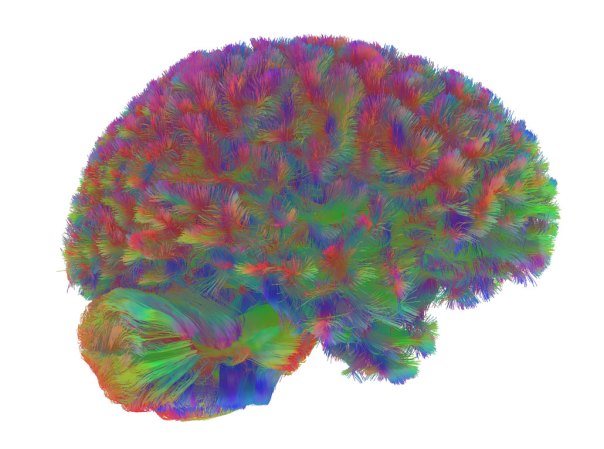
Brain connections largely stabilize between ages 32 and 66. Then, as people grow older, they begin to lose white matter, and their brains lose efficiency. This happens in the so-called early aging (through age 83) and late aging eras.
Understanding that the brain doesn’t change steadily over one’s life can be helpful, Astle said in the Cambridge University statement. How the brain is wired may be linked to a number of mental health and other conditions. “Differences in brain wiring predict difficulties with attention, language, memory and a whole host of different behaviors,” Astle said. So the new findings “will help us identify when and how its wiring is vulnerable to disruption.”
The study “is a new and refreshing way to think about [brain] organization,” says Richard Cytowic. He’s a neuroscientist at George Washington University in Washington, D.C. The new data, he says, confirm that “we change in leaps and bounds, rather than step by step.” It also means that the end of adolescence remains difficult to determine. And, he adds, it leaves open the question of how white matter matures as we age.
So what does this mean for teens?
Researchers, politicians, media and others “have been talking about how people reach adulthood later than they used to,” says Hillary Schwarb. This cognitive neuroscientist works at the University of Nebraska – Lincoln. While the Cambridge study “is important,” she says, “it only looks at one part of the brain, called white matter.” What it doesn’t do, she cautions, is “explain how thinking or behavior changes” over time. As such, it’s the first of many steps needed to better understand how connections inside the brain affect thinking and feeling over our lifespan.
Concludes Schwarb, when it comes to how the brain functions, there’s still much to learn.
Do you have a science question? We can help!
Submit your question here, and we might answer it an upcoming issue of Science News Explores