Brain scans reveal where taste and smell combine to become flavor
A part of the brain called the insula plays a key role in what we interpret as flavor
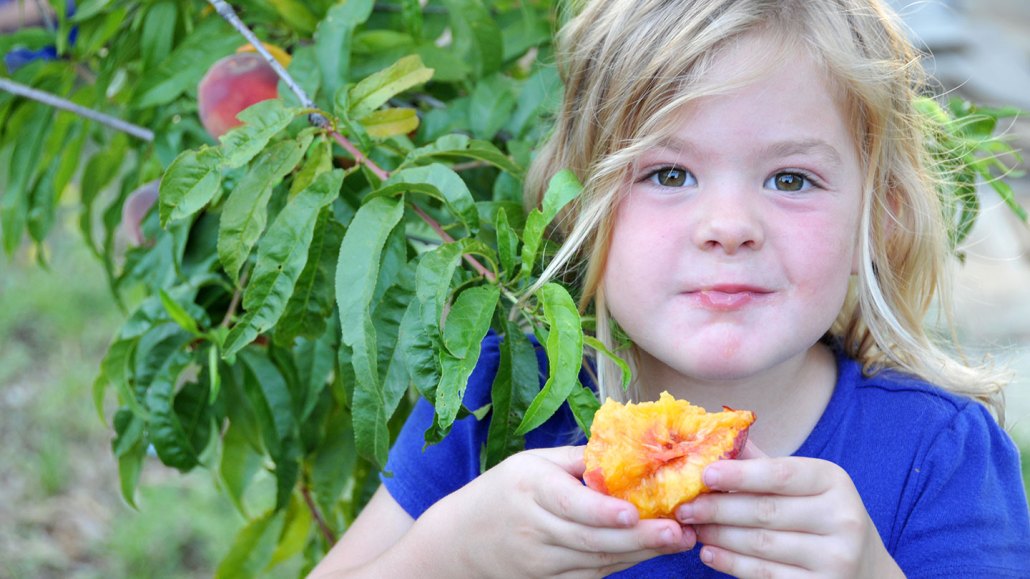
Peaches (and mangoes) both taste mostly sour. But their aromas help make for different flavors. New research pinpoints a brain region that blends smell and taste into that sensation we know as flavor.
Jessica Lynn Culver/Moment Open/Getty Images Plus
Share this:
- Share via email (Opens in new window) Email
- Share on Facebook (Opens in new window) Facebook
- Share on X (Opens in new window) X
- Share on Pinterest (Opens in new window) Pinterest
- Share on Reddit (Opens in new window) Reddit
- Share to Google Classroom (Opens in new window) Google Classroom
- Print (Opens in new window) Print
Flavor isn’t just on your tongue — it’s also in your brain. New scans identify a part of the brain that fuses taste and smell into flavor.
Smell and taste are so connected that a whiff of a well-loved food evokes its taste without any thinking. These senses become linked the moment we bite into something, says Putu Agus Khorisantono. He’s a neuroscientist at the Karolinska Institute in Stockholm, Sweden.
In the body, many compounds bind to sites called receptors. Some food chemicals dock onto the tongue’s sweet, salty, sour, bitter or umami taste receptors. Other compounds — called retronasal odors — travel through the roof of the mouth. They stick to odor receptors in the back of the nose. They can change how we experience flavor.
For instance, mangoes and peaches both taste mostly sour, Khorisantono notes. “It’s really the aroma that differentiates them.”
The brain combines tastes and smells to create our sense of flavor. But science has struggled to find precisely where in the brain this happens.
In the new work, Khorisantono’s team trained 25 people to connect mixtures of smells and tastes with certain flavors. Then they gave these people droplets of beverages. The tiny drinks were designed to activate either taste or retronasal receptors. As this happened, the researchers scanned brain activity in their trainees.
To figure out which brains regions were at work during these tests, the team used machine learning. A type of artificial intelligence, it teaches a computer to do a task. Here, they gave it lots of data from people who labeled key types of information. In this case, a computer program received scanned pictures of the brain. The researchers labeled the scans with the beverage the trainees had sipped when the picture was taken. Computer programs that train in this way are called machine-learning algorithms.
The team narrowed down possible brain regions by isolating different parts of the brain from their scans. Then they used each of these to train machine-learning algorithms.
Khorisantono tested the algorithms’ ability to guess what people had smelled based on the brain images alone. One of the best algorithms had been trained on images from a brain region called the insula.
Forming flavors deep in the brain
Scientists once thought the insula responded only to tastes, Khorisantono says. But by 2017, work with rodents showed the insula could also process smells. Last year, scientists found that some insula cells respond to combinations of smells and tastes. That hinted that it may play a role in identifying flavor.
The new study backs that up: that the insula is key to both smell and flavor.
When participants in the new study got either the retronasal aroma of a specific flavor, or its taste, scans of the insula looked about the same. So the insula likely interpreted these smell and taste signals similarly.
Algorithms trained on other regions also did well. And that may be because they receive flavor signals from the insula, Khorisantono explains.
His team shared its new findings September 12 in Nature Communications
Do you have a science question? We can help!
Submit your question here, and we might answer it an upcoming issue of Science News Explores
The insula monitors organs such as the stomach and intestines. And it subtly influences our eating habits and how we feel about our bodies. But sitting deep in the brain, the insula is hard to study.
In the past, it wasn’t possible to dig into what it does in people because the advanced methods used in this study weren’t available, says Ivan de Araujo. But methods such as machine learning are changing that. De Araujo, who did not take part in the new study, is a neuroscientist. He works at the Max Planck Institute for Biological Cybernetics in Tübingen, Germany.
The new findings could help explain why people crave certain foods and may be repulsed by others, de Araujo says. The new study tested only smells picked up by receptors in the back of the nose. But smells that trigger food cravings when we pass a bakery or restaurant stick to receptors in the front of our noses. He is now testing whether these smells also fire up the insula.