ancestor: A predecessor. It could be a family forebear, such as a parent, grandparent or great-great-great grandparent. Or it could be a species, genus, family or other order of organisms from which some later one evolved. For instance, ancient dinosaurs are the ancestors of today's birds. (antonym: descendant)
birds: Warm-blooded dinosaurs with wings that first showed up at least 150 million years ago. Birds are jacketed in feathers and produce young from the eggs they deposit in some sort of nest. Most birds fly, but throughout history there have been the occasional species that don’t.
dinosaur: A term that means terrible lizard. These reptiles emerged around 243 million years ago. All descended from egg-laying reptiles known as archosaurs. Their descendants eventually split into two lines. For many decades, they have been distinguished by their hips. The lizard-hipped line are believed to have led to the saurischians, such as two-footed theropods like T. rex and the lumbering four-footed Apatosaurus. A second line of so-called bird-hipped, or ornithischian dinosaurs, appears to have led to a widely differing group of animals that included the stegosaurs and duckbilled dinosaurs. Many large dinosaurs died out around 66 million years ago. But some saurischians lived on. They are now the birds we see today (and who have now evolved that so-called “bird-hipped” pelvis).
emu: A large, flightless bird. Only the ostrich is a larger bird. The emu is native to Australia, Indonesia, the Philippines and some South Pacific islands. The animal belongs to a very primitive family within modern birds. It eats fruits, seeds and insects and tends to travel over a broad region rather than settling down in one small area.
evolve: (adj. evolving) To change gradually over generations, or a long period of time. In living organisms, such an evolution usually involves random changes to genes that will then be passed along to an individual’s offspring. These can lead to new traits, such as altered coloration, new susceptibility to disease or protection from it, or different shaped features (such as legs, antennae, toes or internal organs). Nonliving things may also be described as evolving if they change over time. For instance, the miniaturization of computers is sometimes described as these devices evolving to smaller, more complex devices.
extinct: (n. extinction) An adjective that describes a species for which there are no living members.
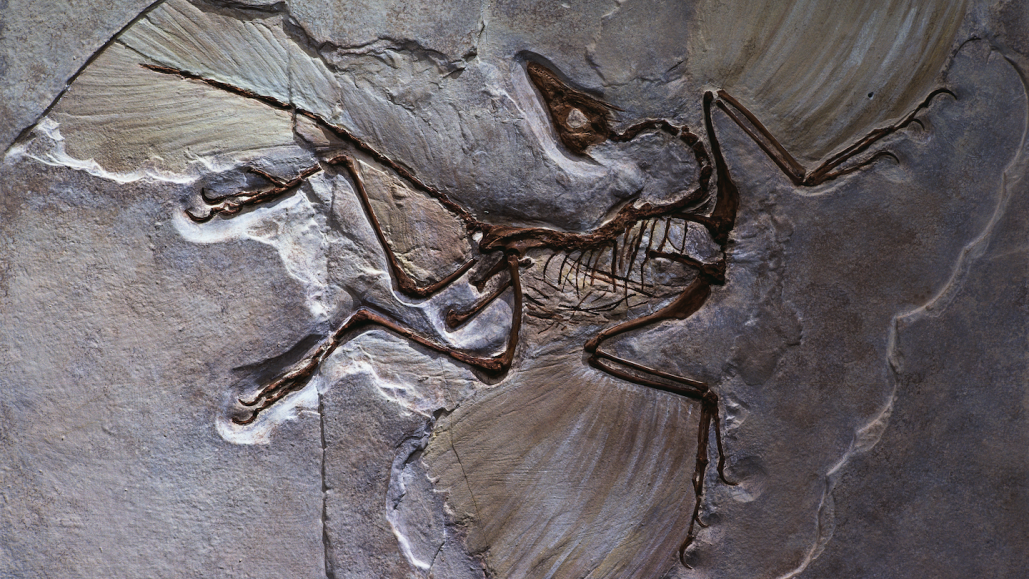
fossil: Any preserved remains or traces of ancient life. There are many different types of fossils: The bones and other body parts of dinosaurs are called “body fossils.” Things like footprints are called “trace fossils.” Even specimens of dinosaur poop are fossils. The process of forming fossils is called fossilization.
herbivore: A creature that either exclusively or primarily eats plants.
imprint: (in animal behavior) A term for process by which a young animal comes to view some other animal (or person or thing) as its parent or trusted caregiver.
link: A connection between two people or things.
omnivore: (adj. omnivorous) An animal whose diet includes foods from both plants and animals.
range: The full extent or distribution of something. For instance, a plant or animal’s range is the area over which it naturally exists. (in math or for measurements) The extent to which values can vary (such as the highest to lowest temperatures). Also, the distance within which something can be reached or perceived.
species: A group of similar organisms capable of producing offspring that can survive and reproduce.
theropod: A usually meat-eating dinosaur that belonged to a group whose members are typically bipedal (walk on two legs). They range from small and delicately built to very large.
Tyrannosaurus rex: A top-predator dinosaur that roamed Earth during the late Cretaceous period. Adults could be 12 meters (40 feet) long.
Velociraptor: A genus of predatory bird-like dinosaurs with a relatively large brain and a long, sharp claw on each foot. Its fossils were first discovered in the 1920s in what is now Mongolia. The roughly meter-tall animal moved on two feet and injured/maimed It would not have been as daunting as its namesake portrayed in the Jurassic Park movie franchise. Many scientists believe that movie version was actually Deinonychus, a dinosaur twice this dino’s size and known from fossils unearthed in the United States during the 1960s.