Questions for ‘Hawaii is turning fishnets and other plastic trash into roads’ 
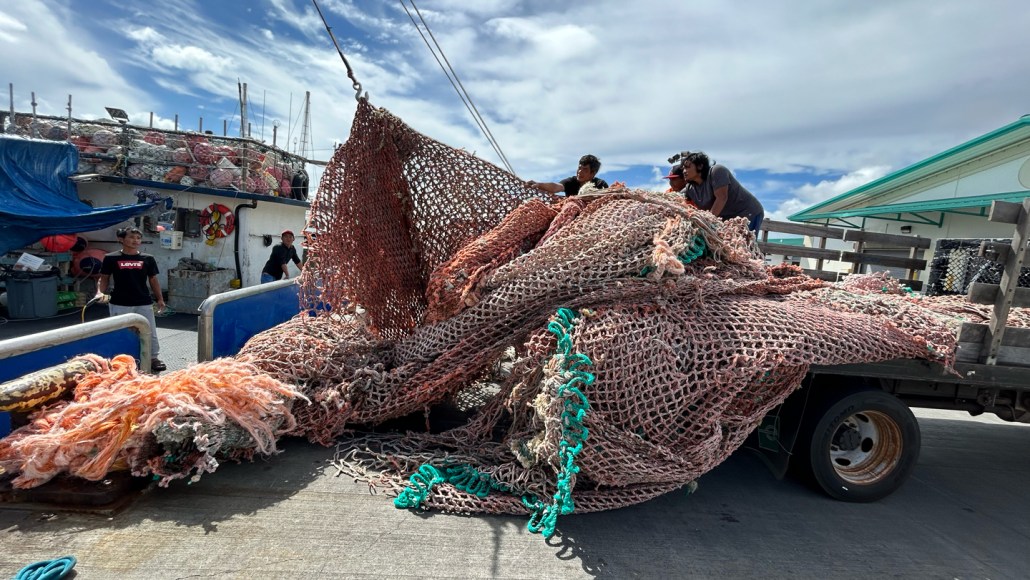
Old, plastic fishing nets being collected into a pile on a trailer.

About 90 metric tons (roughly 200,000 pounds) of plastic has been hauled from the waters and beaches of Hawaii. That includes old fishing nets. Some of this waste has been turned into pellets and added to asphalt for paving some test sections of roads.

Courtesy of the Center for Marine Debris Research

To accompany Hawaii is turning fishnets and other plastic trash into roads’  

SCIENCE

Before Reading:

1. List three types of trash that you discard regularly that contribute to plastic pollution. Pick one of these trash items and speculate on where such an item might end up after one year’s time.

2. Explain, to the best of your knowledge, what microplastics are. What particular concerns do you think researchers might have regarding microplastic pollution?

During Reading:

1. Besides Hawaii, what are two other U.S. states that are currently paving with plastic?

2. How much plastic trash have people pulled from the Pacific Ocean? Give your answer in two different units.

3. What concern does Jennifer Lynch describe regarding the use of plastic as paving material?

4. Compare the composition of the three experimental asphalt test strips laid down in 2022.

5. Researchers collected samples of these test strips eleven months after they were laid down. In the lab, the researchers exposed these pavement samples to conditions that mimic natural conditions in Hawaii. Give one example of a natural process that the scientists tried to mimic.


6. What were the results of their tests? What does this mean for the future of this project?

7. According to Bill Buttlar, Hawaii’s roads face unique challenges. Give one example of an environmental factor affecting Hawaii roads that is uncommon most other places in the world.

8. What does Buttlar describe as the “main challenge” in this project?

After Reading:

1. This article focuses on how pavement made from a mix of asphalt and plastic will hold up under Hawaii’s unique environmental conditions. Consider other places in the world with unusual environmental conditions. Describe one other region where such experiments could be carried out with a focus on mimicking different environmental conditions. Identify two environmental stressors that a research team would need to mimic.

2. The scientists in this study went through an engineering-design process to develop a solution. Using the information in the article, give a short answer to describe what scientists did for each of the following steps.

Define the Problem:

Develop and prototype a solution:

Test the solution:

Communicate the results: