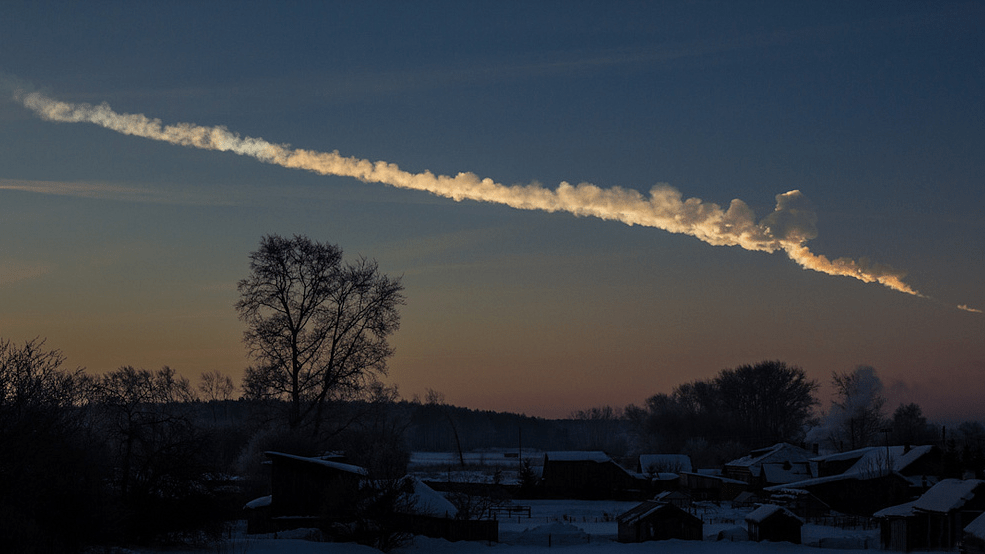
airburst: The term for an explosion that occurs high in the atmosphere. It usually refers to a large explosion, such as one made by a nuclear weapon or the breakup of a meteor.
arc: A curve, often mapping out what appears to be part of a circle.
astronomer: A scientist who works in the field of research that deals with celestial objects, space and the physical universe.
atmosphere: The envelope of gases surrounding Earth, another planet or a moon.
atomic: Having to do with atoms, the smallest possible unit that makes up a chemical element.
atomic bomb: (also atom bomb) A type of “nuclear” weapon that explosively release energy resulting through the bombardment heavy, unstable elements (such as plutonium or uranium) using neutrons. This splits many of the nuclei in a very rapid chain reaction.
magnitude: (in astronomy) A measure of a star brightness.
meteor: (adj. meteoritic) A lump of rock or metal from space that hits the atmosphere of Earth. In space it is known as a meteoroid. When you see it in the sky it is a meteor. And when it hits the ground it is called a meteorite.
moon: The natural satellite of any planet.
planet: A large celestial object that orbits a star but unlike a star does not generate any visible light.
sonic: Of or relating to sound.
star: The basic building block from which galaxies are made. Stars develop when gravity compacts clouds of gas. When they become hot enough, stars will emit light and other forms of electromagnetic radiation. The sun is our closest star.
sun: The star at the center of Earth’s solar system. It is about 27,000 light-years from the center of the Milky Way galaxy. Also a term for any sunlike star.
Venus: The second planet out from the sun. Just as Earth does, it has an iron core and a rocky mantle and crust. Volcanoes on the planet’s surface spewed high levels of carbon dioxide, which built up in the planet’s atmosphere. Today the air pressure at the planet’s surface is 100 times greater than on Earth, and the atmosphere now keeps the surface of Venus a brutal 460° Celsius (860° Fahrenheit).