A bonobo’s imaginary tea party hints that apes can pretend
Kanzi would sometimes play with imaginary juice and grapes
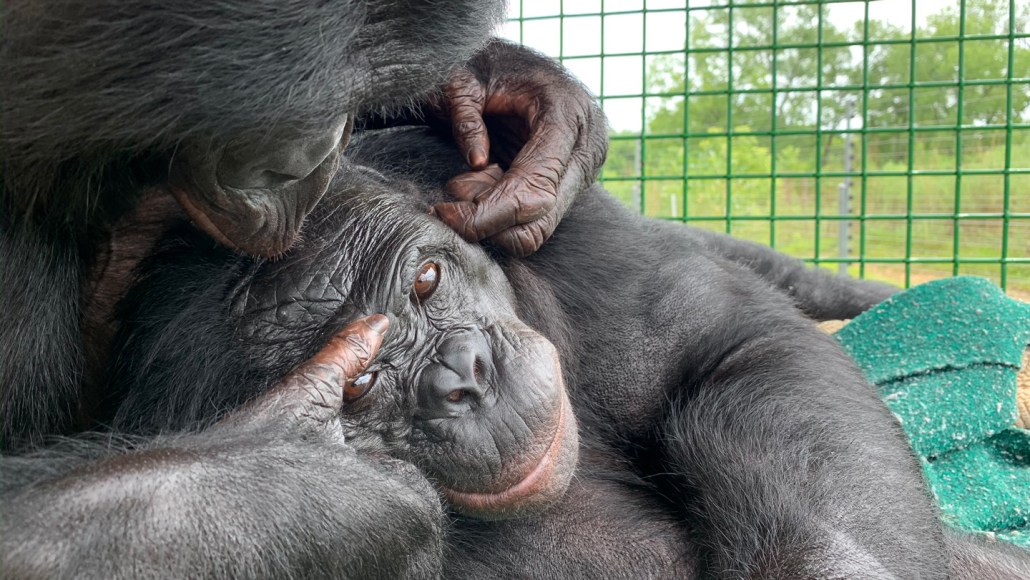
Kanzi, a bonobo that could communicate using symbols in place of words, is groomed by another bonobo, named Nyota.
Photo courtesy of Ape Initiative
Share this:
- Share via email (Opens in new window) Email
- Share on Facebook (Opens in new window) Facebook
- Share on X (Opens in new window) X
- Share on Pinterest (Opens in new window) Pinterest
- Share on Reddit (Opens in new window) Reddit
- Share to Google Classroom (Opens in new window) Google Classroom
- Print (Opens in new window) Print
By RJ Mackenzie
This is a human-written story voiced by AI. Got feedback? Take our survey . (See our AI policy here .)
Humans may not be the only primates with the power to imagine. A bonobo named Kanzi recently showed that he could keep track of make-believe juice and grapes during a pretend tea party.
This finding adds to a growing body of evidence that apes — primates without a tail, such as bonobos and gorillas — can picture things that aren’t really there. Scientists once thought only people did this.
By a year old, human children can start playing pretend. By age three, most kids can build whole imaginary words in their minds. This ability is necessary for many complex tasks.
The new study started with Kanzi, a very special bonobo. He had learned to communicate with scientists using symbols that represent words. Such symbols are called lexigrams.
“We were starstruck by Kanzi,” says Amalia Bastos. She studies behavior and intelligence in animals at the University of St. Andrews in Scotland.
Bastos met Kanzi in 2023. During their first meeting, Kanzi used a board with lexigrams to ask Bastos and a colleague to chase each other. Bastos noticed that the bonobo really enjoyed watching them run after one another, even if it was just pretend.
That got her wondering what other types of make-believe games Kanzi might be able to understand. So she asked Christopher Krupenye for help. He’s a cognitive scientist at Johns Hopkins University in Baltimore, Md. Together, they designed make-believe tests for Kanzi.
Hosting a bonobo tea party
In the first of those, Kanzi sat down at a table with two glasses. A researcher brought out an empty, see-through pitcher. With the pitcher, they pretended to fill up the two glasses with imaginary “juice” — Kanzi’s favorite drink. Then, they poured the imaginary juice from one of the glasses back into the pitcher and asked Kanzi which glass was full.
The bonobo chose the glass that still had make-believe juice more than two out of every three times. That’s a lot more correct answers than if Kanzi were just guessing. But the researchers worried this might not be because he was playing pretend.
“Kanzi is an old bonobo. Maybe his vision isn’t very good. Maybe he thinks that there’s real juice in these things,” says Bastos. So she and her colleagues asked Kanzi to choose between real and fake juice, to make sure he could see the difference.
They gave him two cups. One had real juice in it. The other one was filled with pretend juice, just like before. They asked Kanzi which cup he wanted. Almost eight in every 10 times, Kanzi chose the cup with real juice. It appeared Kanzi could see the juice. He was just willing to play along with the researchers’ game.
The researchers also played the same make-believe game using imaginary grapes. Kanzi got the answer right for that game, too. Bastos’ team shared its findings February 5 in Science.
The power of imagination
When non-human animals such as apes learn to use tools, it’s often considered an accident, says Cathal O’Madagain. But scientists might need to rethink that after the new study. O’Madagain is a cognitive scientist at the University of Mohammed VI Polytechnic in Rabat, Morocco. He did not take part in the new study.
When humans invent new tools, it’s often because they can imagine how they will use them. “You can’t invent a bicycle if you can’t imagine one first,” says O’Madagain. If other animals also have imagination, they could be doing the same.
Bastos last saw Kanzi just two months before he died in March 2025. The bonobo was unique, because he was one of the last apes raised to try to communicate through the methods that humans use. Today, scientists try to study how apes naturally communicate.
Next, Bastos wants to find out if apes that didn’t spend their whole lives around people can also pass the imaginary juice test — and make good guests at a pretend tea party.
Do you have a science question? We can help!
Submit your question here, and we might answer it an upcoming issue of Science News Explores