HS-ESS1-4
Use mathematical or computational representations to predict the motion of orbiting objects in the solar system.
- Planets
Research on exoplanets took top award at 2023 Regeneron ISEF
Six young researchers took home the top awards, each valued at a minimum of $50,000. Hundreds more shared nearly $9 million in prizes at international event.
- Tech
A new solar-powered gel purifies water in a flash
The unusual, fruit-inspired structure of this material provides quick filtration that could satisfy people's daily water needs.
- Space
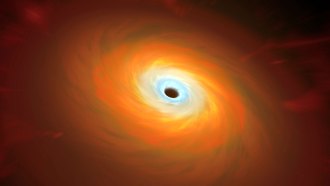
Scientists Say: Accretion Disk
Cosmic swirls of gas, dust and plasma, accretion disks reveal the shadowy silhouettes of black holes and more.
- Planets
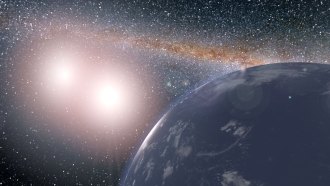
Planets like Star Wars’ Tatooine could be fit for life
Like Luke Skywalker’s home, planets orbiting two stars may be plentiful. A new computer model suggests that many of those worlds could sustain life.
- Earth
Scientists Say: Equinox and Solstice
Equinoxes and solstices mark the maximums, minimums and mediums of hours spent in daylight.
- Space
Spacecraft traveling through a wormhole could send messages home
A probe going through a wormhole should be able to send messages home before such a tunnel forever closes, a new computer model finds.
- Math
Scientists Say: Calculus
Calculus is math that deals with curves, from their changing slopes to the areas they enclose.
- Space
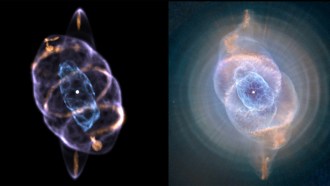
Jets may have sculpted rings of Cat’s Eye nebula
The Cat’s Eye nebula is one of the most complex of its kind. A 3-D model now reveals the source of that complexity.
- Earth
Scientists Say: Pole
A pole is either of two opposite ends of a molecule, magnet, battery, planet or other object.
- Planets
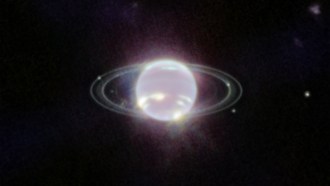
Check out the first direct look at Neptune’s rings since the ’80s
The Voyager 2 spacecraft took the first pics of Neptune’s rings 33 years ago. Now, NASA’s James Webb telescope is providing a more detailed view of them.
- Physics
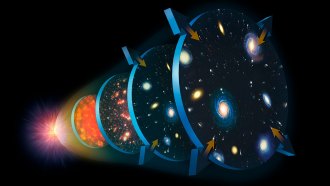
Mysteries about the universe abound, from its beginning to its end
Scientists have a good understanding of the laws that make our universe tick. But they still don’t quite know how it began — or will end.
- Space
NASA’s DART spacecraft successfully bumped an asteroid onto a new path
The spacecraft’s intentional crash into an asteroid changed the space rock’s orbit by more than 30 minutes — far more than expected.