HS-ESS1-4
Use mathematical or computational representations to predict the motion of orbiting objects in the solar system.
- Planets
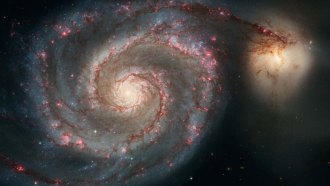
Astronomers may have found first known planet in another galaxy
The spiral-shaped Whirlpool galaxy may be home to the first planet spotted outside our own Milky Way galaxy.
- Planets
Pluto is no longer a planet — or is it?
In the 15 years since Pluto lost its status as a planet, some scientists continue to use whatever definition works best for them.
- Earth
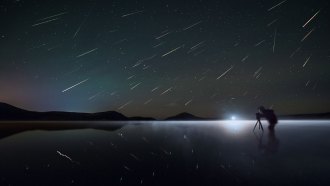
Let’s learn about meteor showers
Meteor showers happen when Earth’s orbit passes through trails of debris left behind by comets or asteroids.
- Earth
Moon’s orbital wobble can add to sea-level rise and flooding
In a dozen years or so, the tide-enhancing effects of a wobble in the moon’s orbit should lead to dramatically higher sea levels in some coastal cities.
- Planets
This image may be the first look at exomoons in the making
These observations offer some of the best evidence yet that planets around other stars have moons, or exomoons.
- Planets
Born in deep shadows? That could explain Jupiter’s strange makeup
Dust that blocked sunlight might have caused the gas giant to form in a deep freeze, a new study suggests.
- Space
Cosmic filaments may have the biggest spin in outer space
These rotating threads of dark matter and galaxies stretch millions of light-years. Scientists want to know how their spin begins.
- Space
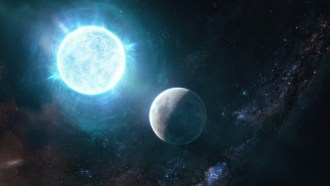
Moon-sized white dwarf is the smallest ever found
This dead star is also spinning very fast and has an amazingly powerful magnetic field.
- Physics
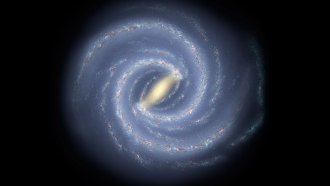
Spin in this Milky Way bar may show cosmic dark matter does exist
A method akin to studying a tree’s rings reveals the timeline of a slowdown in those stars at the heart of our Milky Way galaxy.
- Space
Huge arc of galaxies is surprising and puzzling cosmologists
The arc appears to violate a cosmic rule that on such large scales, matter will be evenly distributed.
- Physics
Stars made of antimatter could lurk in our galaxy
Fourteen sources of gamma rays in our galaxy look like they could be antistars — celestial bodies made of antimatter.
- Physics
The pebbled path to planets
Small pebbles zipping through a sea of gas may give rise to mighty planets.