HS-ESS1-4
Use mathematical or computational representations to predict the motion of orbiting objects in the solar system.
- Space
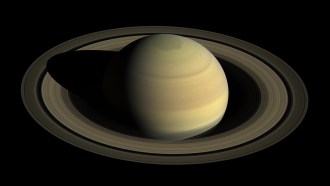
A missing moon could have given Saturn its rings — and tilt
The hypothetical moon is being called Chrysalis. It could have helped tip the planet over before getting shredded to form Saturn’s rings.
- Tech
NASA’s DART spacecraft crashed into an asteroid — on purpose
This mission could provide a blueprint for how to deflect a killer asteroid, if one is ever found headed for Earth.
- Planets
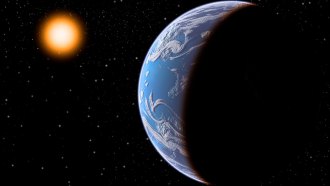
Scientists Say: Habitable Zone
The habitable zone is the region around a star where temperatures could be right for worlds to host liquid water.
- Planets
Ancient volcanoes may have left ice at the moon’s poles
Volcanic eruptions billions of years ago may have produced several temporary atmospheres on the moon that held water vapor.
- Space
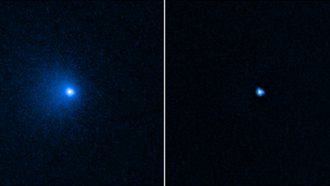
Behold: The biggest known comet in our solar system
This “dirty snowball” in space is about twice as wide as Rhode Island and darker than coal.
- Planets
Analyze This: Some 5,000 planets orbit stars other than our sun
A new cache of confirmed exoplanet discoveries marks a milestone in planets found beyond our solar system.
- Physics
Explainer: All about orbits
A handful of rules can describe the route some object repeatedly takes around another in space. Calculating that path, however, can be quite complex.
- Space
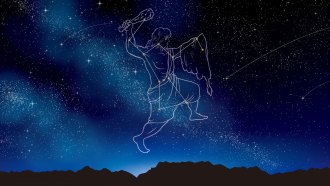
Scientists Say: Constellation
Constellations are clusters of related things, especially the stars that form patterns in the night sky — some of which date back to ancient times.
- Tech
Space trash could kill satellites, space stations — and astronauts
As private companies prepare to sprinkle space with tens of thousands of satellites, experts worry about the mushrooming threat of space junk.
- Physics
Scientists Say: Dark Energy
Dark energy is the unknown force causing the universe to expand faster and faster.
- Environment
Explainer: Gravity and microgravity
The force of gravity holds us on the ground, keeps planets in orbit and extends throughout space. A very weak gravitational pull is called microgravity.
- Planets
The long-awaited James Webb Space Telescope has a big to-do list
The James Webb Space Telescope has been in the works for so long that new fields of science have emerged for it to study.