Physics
- Physics
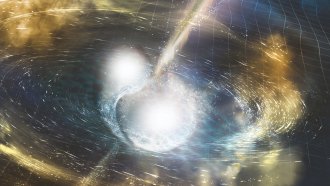
Let’s learn about gravitational waves
Gravitational waves offer scientists a new way to view extreme objects such as black holes and neutron stars.
- Materials Science
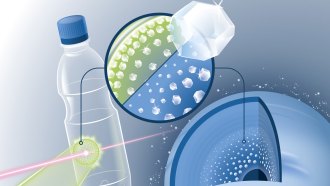
Laser light transformed plastic into tiny diamonds
The technique could be used to make nanodiamonds for quantum devices and other technology.
- Physics
Scientists Say: Force
When an object experiences a force, its change in motion — or acceleration — depends on its mass.
- Physics
Scientists Say: LED
LEDs, or light-emitting diodes, light up TV screens, traffic lights and many other devices used in daily life.
- Earth
Amateur astronomers reveal clues to a mysterious double aurora
Stunning images from citizen scientists show an unusual pattern in ‘Northern Lights.’ They offer clues that may help astronomers better understand a curious red glow.
- Chemistry
Cool Jobs: Scientific glassblowers shape science
Glass has played a major role in research for centuries. Today’s artisans work at the forefront of discovery.
- Physics
This leaping robot can out-jump anything — animal or machine
Such a bounding bot might someday help explore the moon.
- Physics
Explainer: How the Doppler effect shapes waves in motion
The Doppler effect describes how waves are compressed or stretched when their source — or receiver — is moving.
- Chemistry
Scientists Say: Pigment
From fruits to fur to fine art, many materials get their colors from compounds called pigments.
- Physics
Let’s learn about music
Researchers are delving into how instruments and spaces shape our experience of music, and how computers could play a role in the future of music-making.
- Chemistry
Scientists Say: Proton
These positively charged particles are important building blocks in atoms.
- Physics
Scientists used lasers to make ‘smoke rings’ of light
Physicists had a bright idea: Make light into swirling, ring-shaped vortices, similar to smoke rings or bubble rings.