Physics
- Climate
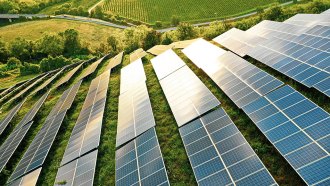
Let’s learn about solar power
Solar power is a way to harness energy from the sun, and lessen our reliance on fossil fuels.
- Physics
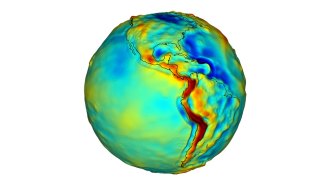
Scientists Say: Gravity
Gravity is a fundamental force that attracts objects with mass to other objects with mass. It decreases with distance.
- Physics
Trees power this alarm system for remote forest fires
Wind moving through tree branches is all the energy needed to power devices that can detect a remote fire before it rages into an uncontrolled inferno.
- Physics
This high-tech sweeper is designed for super-clingy moon dust
An electron beam is the newest tool being developed to remove sticky and damaging lunar dust from surfaces.
- Physics
2020 Physics Nobel goes for delving into black holes
Although Einstein’s general theory of relative suggested black holes might exist, this year’s winner’s helped show they actually are out there.
- Physics
How physics lets a toy boat float upside down
Buoyancy’s upward force keeps objects afloat even in unusual conditions.
- Chemistry
How to recycle ‘nonrecyclable’ plastics
A new process can convert some nonrecyclable plastics into a type that now can be reused. That could greatly cut down on wastes sent to landfills.
- Archaeology
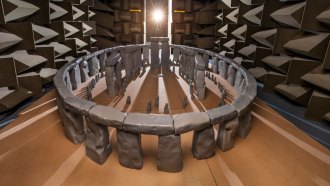
Stonehenge enhanced voices and music within the stone ring
Scientists built a 'Stonehenge Lego' model in a sound chamber to study how sound would have behaved in the ancient stone circle.
- Physics
Strange but true: White dwarfs shrink as they gain mass
Telescope observations of thousands of these stars now confirm a decades-old theory on how their masses relate to their waistline.
- Physics
The exotic ‘atom’ positronium surprises scientists
New measurements of a weird but simple atom, one without a nucleus, suggest it may have unexpected properties. Scientists find this troubling.
- Animals
Quacks and toots help young honeybee queens avoid deadly duels
It’s not just ducks that quack. Honey bees do it too. They also toot. Researchers eavesdropped on hives to find out why.
- Materials Science
Will bacterial ‘wires’ one day power your phone?
An accidental discovery helps scientists generate electricity out of thin —but humid — air with bacteria-made protein nanowires.